Zero‑Click Era: After AI “snatches” website traffic, how can you recover it?
Open the site’s backend: rankings haven’t dropped much, but organic traffic is slipping. Checking keyword rankings shows most are still in place, yet click‑through rates are falling. Users get answers directly from ChatGPT or Google AI Overviews and never click your link. The content team keeps writing long‑tail articles the the old way, while traffic is being “freeloaded” by AI.
This isn’t a phenomenon unique to a particular industry; it’s a structural shift that almost every independent site is facing. Instead of fighting zero‑click, turn your content into a source AI is willing to cite, and capture the purchase‑decision searches that still generate clicks. Do both correctly, and the traffic structure can stabilize again.
Zero‑click isn’t a prophecy; it’s today’s reality
Zero‑click search refers to a user’s search ending without any click on a natural result. The answer is displayed directly on the search results page, giving the user no reason to navigate elsewhere. Google AI Overviews, ChatGPT, Perplexity, and Bing AI are all new information entry points.
A frequently cited editorial observation: roughly half of search sessions end with zero clicks. This figure is especially pronounced for informational queries—users ask “What is AEO?” or “How to optimize title tags,” and AI provides the answer, leaving the site no exposure at all.
But zero‑click isn’t evenly distributed. Clicks on informational queries are disappearing, while clicks on transactional queries persist. If a user asks “Which coffee machine is suitable for an office?” AI may recommend a few products, but the user will most likely still click into a product page to see price, reviews, and shipping time. Those clicks haven’t vanished; they’ve just become more selective.
For independent sites, this means the traffic structure is shifting: exposure and clicks generated by informational content are shrinking, while traffic from purchase‑decision content remains relatively stable. The operational judgment should be to adjust the content focus, not to keep pouring effort into long‑tail Q&A that no longer receives clicks.
First, understand the traffic flow: who is decreasing, who is still there
Divide queries into three categories; the behavioral differences are clear. Click‑through rates for informational queries keep falling in a zero‑click environment, navigation queries stay relatively stable but limited in volume, and transactional queries have a noticeably higher click‑through rate than informational ones. This isn’t speculation; it’s visible directly in backend data.
When AI cites a source, it also steals brand exposure. A user asks “How do independent sites do SEO?” and AI cites a blog post, but the user doesn’t click the blog—brand exposure occurs, but traffic doesn’t arrive. That’s the most frustrating part of the zero‑click era: you’re seen but not clicked.
The good news is that purchase‑intent searches still bring traffic. Users search with a budget and clear needs; AI can’t provide a complete purchasing decision, so the user eventually clicks a product page or buying guide. Click‑through rates for these queries remain healthy even in a zero‑click environment.
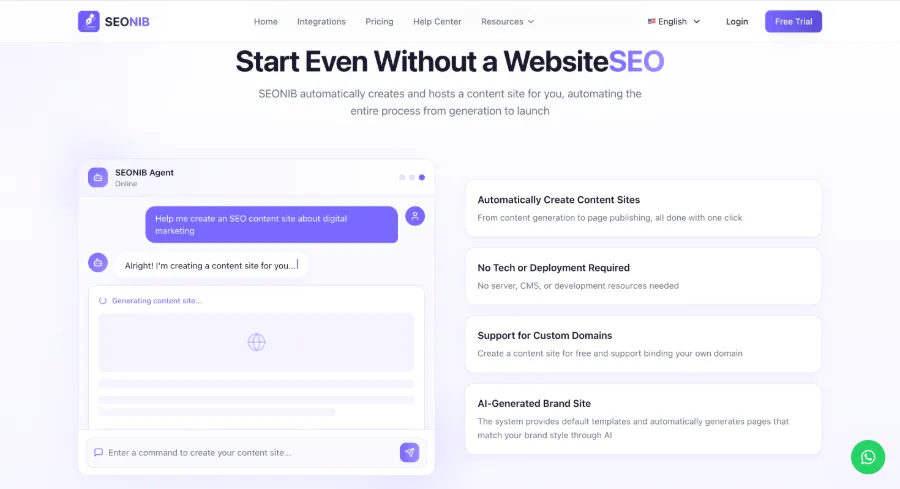
Another noteworthy phenomenon: brand sites and even sites with zero backlinks can still be cited by AI. When AI selects sources, it doesn’t rely solely on backlink count; it values fresh content, clear entities, and structured answers. Some teams have verified that a new site with no backlinks can be cited and receive traffic by choosing the right topics. The fact that a domain name can quickly generate a content‑site interface demonstrates that the cost barrier to building a site is now negligible; the real barrier lies in content quality and update frequency.
Here’s a counter‑intuitive observation: the zero‑click era actually eliminates clicks on informational queries, while purchase‑decision queries still drive traffic. Content focus should shift from “keyword stuffing” to “facilitating purchase decisions,” not to merely increasing keyword coverage.
Let AI cite you: turn your site into a readable source
Traditional SEO writes content to rank, aiming for the top three pages of search results. AEO (AI Engine Optimization) writes content to be cited, aiming for AI to reference your site when answering questions. The two logics are completely different, yet they can run in parallel.
Writing for citation means making your pages “readable” by AI. This requires structured Q&A pages and entity pages (Entity SEO) that give clear entities, brand voice, and product information for AI to reference. A page that both defines an entity clearly and presents a structured Q&A format is far more likely to be cited than a plain, unstructured article.
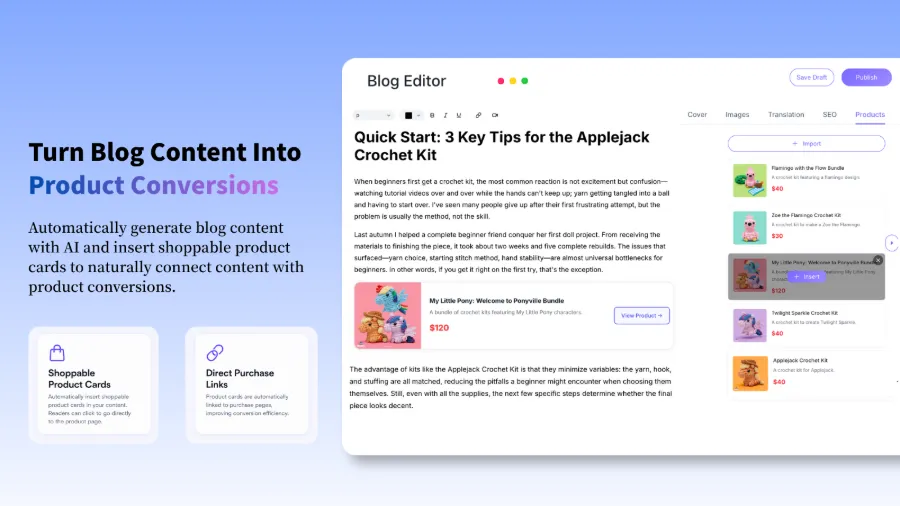
In practice, converting product links and product pages directly into blogs and buying guides is the most efficient path. Product pages already contain product information, specifications, and use cases—perfect material for generating buying guides and review content. One team documented this process in Turning product pages into blogs: a concrete guide, whose core idea is to reuse existing product information instead of starting from scratch.
Technical SEO can’t be ignored either. No matter how good the content, if crawling or parsing fails, AI can’t read it. Internal linking rules, structured data, and page load speed are foundational items that determine whether content is truly crawlable and parsable. You can cross‑check against the 2026 Technical SEO Checklist item by item; many sites have fine content but suffer from technical issues.
From a workflow perspective, importing product links → generating articles → publishing is a chain that, if done manually, requires copy‑pasting, image selection, and SEO fields for each article—time‑consuming. Handing this chain to a tool like SEONIB automates the process: after importing product links, a structured article is generated automatically, complete with product cards and brand information, ready to publish. The content generation supports 40 languages, saving not only translation costs but also repetitive maintenance across multiple sites for A demo of converting product pages into AEO Q&A content can be found in One‑click conversion of e‑commerce products into AEO Q&A content.
Keep the content pipeline running automatically for the long term
The real problem with a manual content pipeline is stagnation. Topic selection relies on news scanning, writing uses ChatGPT, formatting is done manually, and publishing requires logging into the backend one by one—this workflow can survive a month or two, but after six months it inevitably stalls. When content stops, topical authority drops, and AI’s source‑selection shifts toward continuously updated sites.
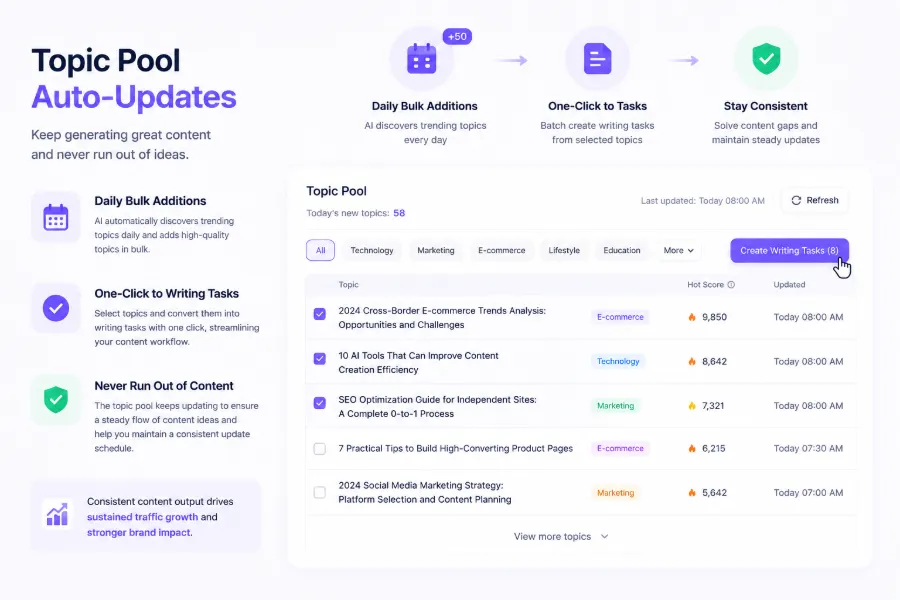
Break content production into four stages: topic selection, generation, scheduling, multi‑platform sync. Each stage has an automation solution. A topic pool can automatically monitor industry trends and competitor content, adding new topics in bulk daily and converting them to writing tasks with one click; the generation stage takes keywords, product links, or trending topics and outputs SEO‑ready articles; scheduling executes publishing frequency automatically; publishing syncs to multiple platforms in one go, eliminating the need to log in individually.
A often‑underestimated point: update frequency itself is part of topical authority, not a secondary metric. When AI selects sources, it prefers sites that update continuously, have clear entities, and provide structured answers. A site that reliably publishes three articles a week is more likely to be cited than a site that churns out a high‑quality long article once a month.
| Workflow Step | Manual Process | Automated Process |
|---|---|---|
| Topic Selection | Scan news, manually judge hot topics | Auto‑monitor trends, daily topic push |
| Content Generation | ChatGPT output then manual copy | Auto‑generate and standardize formatting |
| Formatting & SEO Info | Add images, fill meta per article | Auto‑image, built‑in SEO optimization |
| Multi‑Platform Publishing | Log into each backend separately | One‑click publish, auto‑sync across platforms |
| Update Frequency & Stagnation | Relies on willpower, easy to stall | Scheduled tasks run automatically, continuous output |
The four‑step pipeline forms an automated loop; one generation can sync to multiple platforms, eliminating individual logins. This logic works on Shopify, WordPress, and Shopline. SEONIB’s Shopify app store page is live; after installation, you operate directly from the Shopify backend. Documentation for bulk‑publish data sources is also available, and you can review it before configuring.
Implementation isn’t complex: first build a brand knowledge base with brand voice, industry terminology, and product info; then set internal linking rules so generated content automatically includes relevant links; finally set a publishing frequency so the pipeline runs itself. Further guidance is available in the SEONIB Help Docs, which cover the full configuration from site building to bulk publishing.
FAQ
Do we still need traditional SEO rankings in the zero‑click era?
Yes, but the goal shifts. Traditional SEO rankings remain important because higher‑ranked pages are more likely to be selected as AI citations. Rankings don’t directly bring clicks, but they create citation opportunities. Shift effort from pure informational long‑tail keywords to purchase‑decision keywords and structured Q&A pages.
How can I tell if my content is being cited by AI?
The simplest method is to paste your site’s domain into ChatGPT, Perplexity, or Google AI Overviews and ask a question; see if the answer cites your content. You can also search using a combination of brand and industry terms and observe whether AI responses include your site. Regular testing reveals trends in citation frequency.
What’s the relationship between AEO and traditional SEO; which should I do first?
AEO and traditional SEO are not replacements; they are different optimization objectives within the same tech stack. Traditional SEO focuses on ranking; AEO focuses on citation probability. First ensure a solid SEO foundation—crawling, indexing, page speed—then invest in AEO‑structured content. Without a strong technical base, AEO efforts won’t pay off.
Will AI‑generated content be flagged as duplicate and lose traffic?
It depends on quality. Bulk‑generated content that is repetitive, lacks clear entities, or omits brand information can be deemed low‑quality. However, structured content with clear entities and brand voice, combined with internal linking and regular updates, can be indexed normally and attract traffic. The key is providing informational value, not the generation method itself.
Share Article