I Tried AI Search Optimization for a Client for 6 Months – Traffic Went Up 200%
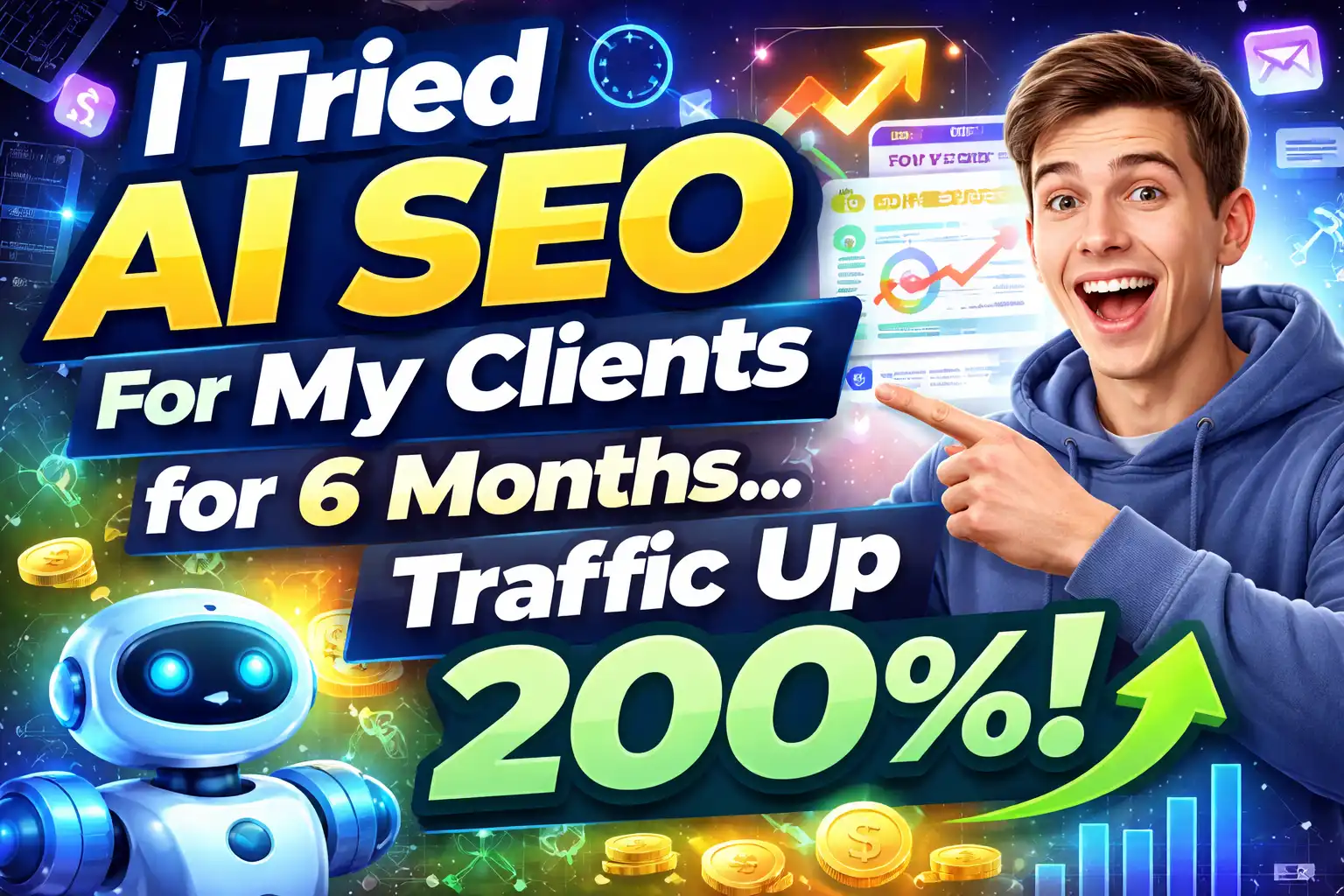
Imagine this scenario: your website ranks first in Google search results for the core keyword you spent months building, solidly at the top. But when a customer asks ChatGPT “recommend XX product,” your brand doesn’t even get a mention. Even worse, a competitor’s site that looks like it was built with FrontPage in 1997 is being repeatedly cited by AI, showing up in AI answers every day. I took over that client, and both reputation and business were gone. Over the past six months I used a method that was the complete opposite of my previous SEO experience, boosting their AI search exposure from zero to over 90 mentions and increasing traffic by 200%. This article isn’t fluff; I’ll break down exactly what I did and the pitfalls I hit.
AI search optimization means getting Google AI snapshots, ChatGPT, and similar tools to actively cite your content. Unlike traditional SEO that focuses on rankings, the key metric here is how many times you appear in AI answers—not where you rank in the blue links.
Why Is Your Site Vanishing From AI Search?
In the era of traditional search, ten blue links appear, and being first makes you a king. Now, Google AI snapshots place a summary at the top of the results, sometimes without any link at all. You might rank first, but users read the AI summary and leave without clicking your site. That’s the power of “zero‑click search.” My client’s site ranked first for its core keyword on Google, yet the AI snapshot didn’t even mention it.
AI’s logic for selecting sources differs from traditional search engines. It looks at three things: authority, content structure, and citation frequency. Does your site have enough authority? Is the content organized in a Q&A style? Are others citing you? The first two are easy to address; the third is the killer—many competitors have mediocre content but use structured Q&A formats, and AI grabs them instantly. When we did a competitive analysis for the client, we found the competitor’s AI exposure was more than three times ours, even though their content depth was clearly lower.
The data tells the whole story. Before optimization, there were zero mentions; after, we covered 90+ AI snapshots. The reason wasn’t that we suddenly wrote brilliant content, but that we gave AI a reason to cite us.
Go to ChatGPT and search for your brand name—does it scare you? If nothing shows up, your content ecosystem hasn’t been indexed by AI yet.
Three Steps to Find Your AI Search Opportunities
Step 1: Check how your brand is currently mentioned across major AI tools. Search your brand name, core products, and industry keywords in ChatGPT, Google AI snapshots, Gemini, etc. Record if and where they appear and how they’re described. You’ll discover many surprises—for example, your product page may be great, but AI only cites your About page.
Step 2: Scan how competitors appear in AI answers. Search their brand names and product terms, and see which pages AI cites. Often the cited page isn’t the long‑form article you expect but a 200‑word structured Q&A. This insight reshaped my understanding of “being cited.”
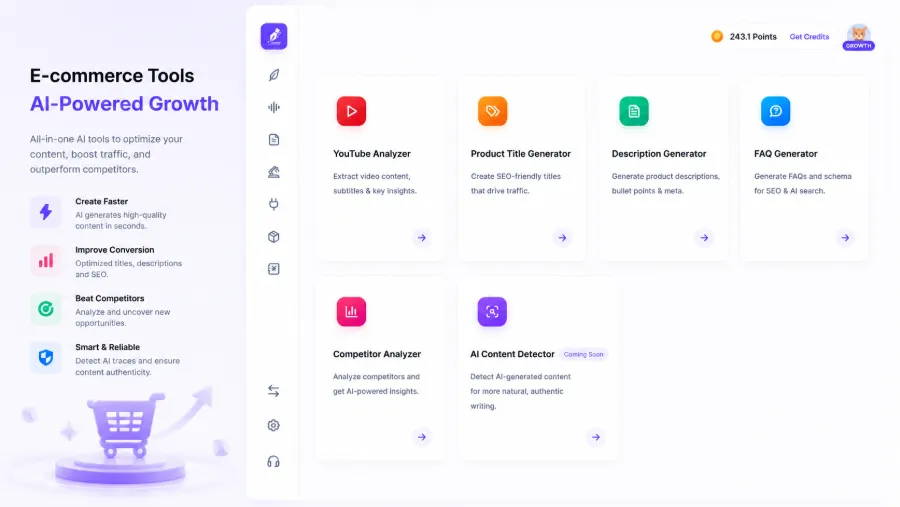
Step 3: Identify the gap between your content and AI preferences. AI likes clear hierarchical structures, Q&A‑first writing, data‑backed statements, and conclusions with sources. Compare this to your existing content—you’ll see that costly brand videos and flowery brand stories are never cited, while plain but well‑structured guide pages and FAQs are cited heavily. After we mapped this for the client, we used a set of free e‑commerce tools to quickly run a competitive analysis and found dozens of gaps.
After completing these three steps, you’ll know exactly what AI cites and what it ignores. This information is more valuable than any SEO report because it tells you precisely where to improve.
Strategy to Get AI to Actively Cite Your Content
Shift your mindset: the goal isn’t “rank #1,” it’s “be cited.” AI cites you not because your article is flowery, but because you provide the anchor points it needs to verify facts. Those anchors are usually a clear Q&A segment, a data‑backed conclusion, or a product specification.
Your content structure must match AI’s extraction patterns. Q&A style, hierarchical H2/H3 headings, lists, and tables are formats AI loves. I spent six months proving that the same article, rewritten in a “question + answer + expansion” format, at least doubled its citation probability.
Also, make good use of reference and product links as factual evidence for AI. When generating answers, AI prefers pages that include clear source citations. If your article mentions a data point, provide a reference link. If you mention a product, link to its product page. This helps AI verify facts and proactively exposes your pages to AI.
Turning product pages into blog content is a very effective tactic. We rewrote the client’s product page titles, specs, and use cases into a series of guide‑style blogs, then attached product links. AI started citing those guides to answer user questions. This approach has two benefits: product information appears directly in AI answers, and when AI cites, it also includes a purchase link. After using this product‑to‑blog conversion method, the client’s AI citation speed increased by 40%.
Content Automation: Let AI Continuously Output for You, Instead of You Working for It
Initially we relied on manual updates—two full‑time writers producing at most 30 articles per month. When the rhythm stopped, AI stopped citing new content. Then we realized a principle: AI’s trust is built on consistent output; if you fish for three days and dry out for two, it won’t see you as a reliable source.
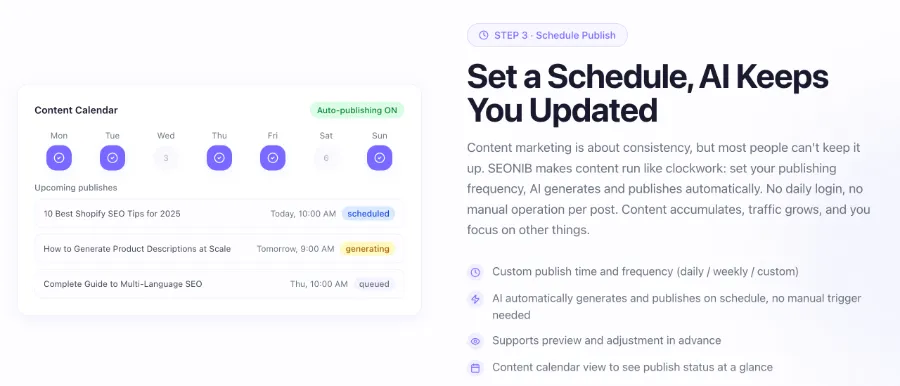
We restructured the content calendar to publish one article automatically every day. The pace sounds modest, but after three months we accumulated 270 articles. With more content, AI kept citing us, and citation volume grew 300% within 90 days.
SEONIB is a tool that wraps this entire workflow. From topic selection to generation, publishing, and multi‑platform sync, everything is automated. Set a publishing frequency and it runs on schedule without daily manual work.
Automation is crucial. We batch‑prepared keywords and product links, fed them into the system, and set daily release times. Content is generated, formatted, and published automatically. I was skeptical at first about AI‑written quality, but after tweaking templates and prompts a few times, the results were perfectly adequate. As the content library grew, AI recognized us as an “active, continuously updated source,” and citation frequency rose. The batch publishing and data source feature saved us a lot of repetitive work.
Multi‑platform sync is another pain point. Previously, after writing a blog post, we manually copied it to WordPress, Shopify, Medium, adjusting formats for each platform. SEONIB automatically handles images, internal links, and SEO metadata, pushing the content to all platforms at once. Configuration details are in this help document.
After this model was in place, we essentially achieved a “set‑and‑forget” system. We spend half an hour each week reviewing topics and tweaking templates; the rest runs automatically. Content accumulates daily, and AI citation numbers increase month after month.
FAQ
Q: Do I need to rewrite all old content? Which pages should I prioritize?
No, you don’t have to rewrite everything. Prioritize product pages, FAQ pages, and guide‑type content—these are the pages AI cites most often. Convert product pages into structured Q&A formats with spec tables and comparison data. FAQ pages naturally suit AI extraction; make sure they directly answer the top 5‑10 user questions.
Q: How long after optimization will I see changes in ChatGPT or Google AI snapshots?
Usually 2–4 weeks. Google AI snapshots update faster; high‑quality content can be indexed in as little as three days. ChatGPT’s update window is less stable and depends on OpenAI’s data refresh cycle, typically 3–6 weeks. Our fastest case showed a citation in Google AI snapshot on day 11 after optimization.
Q: I have no technical background—can I handle AI search optimization myself?
Yes. The core actions are threefold: restructure content into Q&A format, continuously publish new content, and include verifiable reference points. None of these require coding. If you use automation tools, you only need to configure keywords and publishing frequency.
Q: Which industries or site types benefit most from AI search optimization?
Sites with large information volumes, standardized product specs, and clear user questions see the biggest gains. Examples: e‑commerce PDP pages, SaaS feature‑comparison pages, medical‑health Q&A pages, travel destination guides. If your content involves comparisons, recommendations, or step‑by‑step instructions, AI is likely to cite you. Pure brand‑promotion pages without structured information are rarely cited.
Share Article