
After I Stopped Handwriting Articles, SaaS Traffic Doubled
Opening the dashboard, the traffic curve was as flat as an electrocardiogram—this was the result of manually updating my blog for three months. Every day I pulled topics from Google Trends, copied and pasted between ChatGPT and the editor, then logged into three platforms to publish. The repetitive work made me question my life. Later I realized the whole process could be handed over to an automated pipeline, and I only needed to sit beside it watching the data rise.
During that time I did the math: I spent more than 15 hours a week on content, but natural traffic remained unchanged. What finally convinced me to try letting go was the realization that search engines don’t care how much effort you put into a single article; they only care whether you keep updating. If you’re still manually writing every blog post, your site may already be “asleep” in the eyes of search engines.
Why SaaS Must Continuously Feed Content to Search Engines
Search engines have a clear preference for fresh content. A site that publishes 2–3 blog posts per week gets, on average, 3.5 times more organic traffic than a site that never updates—according to Ahrefs’ 2024 report. For SaaS sites, content accumulation directly affects domain authority and keyword rankings. Google’s E‑E‑A‑T logic is simple: a site that consistently produces relevant content is more trustworthy than one that updates only twice a year.
But manually maintaining this is painful, as anyone who has done it knows. Topic selection requires data, drafting requires revisions, formatting needs images inserted one by one, and publishing means logging into three back‑ends. After three months I found myself spending more and more time on content operations, while traffic actually declined. Ironically, the long articles I wrote ranked no higher than the ninth page.
If you’re in a similar predicament, start by checking out this complete SEO optimization guide; it helped me clarify content strategy and the basic logic search engines use to evaluate pages. But honestly, the thing that actually turned the traffic curve around wasn’t learning more theory—it was completely dropping the labor‑intensive content production.
The Four Core Elements of Content Production After Automation
After abandoning manual writing, I began to dissect the entire content workflow. I eventually discovered that the four most critical steps—trend discovery, content generation, scheduled publishing, and multi‑platform synchronization—can each be handed over to an automated pipeline. I used to have to do every step manually; now I just set the rules and let SEONIB handle the rest.
Trend Discovery: Never Run Out of Topics Again
The hardest part isn’t writing; it’s finding a worthwhile direction each day. After automation, AI monitors industry buzz and competitors’ content gaps in real time, pushing topics with search demand straight into the idea pool. I no longer need to browse Google Trends or competitor sitemaps; each morning I glance at the pushed ranking and pick two or three topics to generate.
Content Generation: Anything Input Can Produce an Article
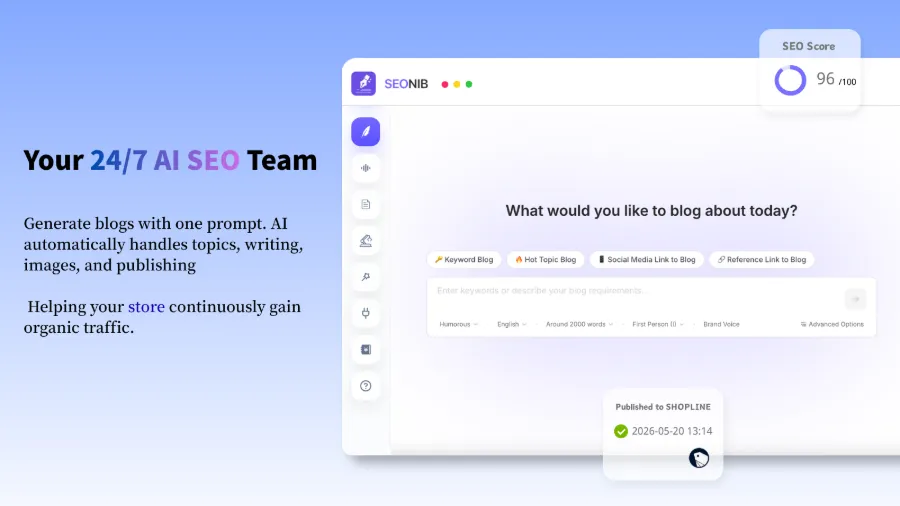
If you think automatic content generation is “give a keyword, get a generic article,” you’re outdated. Modern automation can produce fully structured SEO articles from keywords, product links, hot topics, social media posts, or even reference links. For example, when I input a product’s Shopify link, the AI automatically creates a buyer’s guide that includes a product comparison table and usage scenarios.
If you want to see specific content sources, check out the five ways to automatically generate blog articles; it lists conversion paths from products, keywords, and social media links.
Once the frequency is set, the AI can continuously output content for 90 days without interruption. I roughly spend ten minutes every two weeks reviewing the topic queue, deleting unsuitable ideas, and the system automatically slots the rest into the publishing queue.
Scheduled Publishing: Content as Punctual as an Alarm Clock
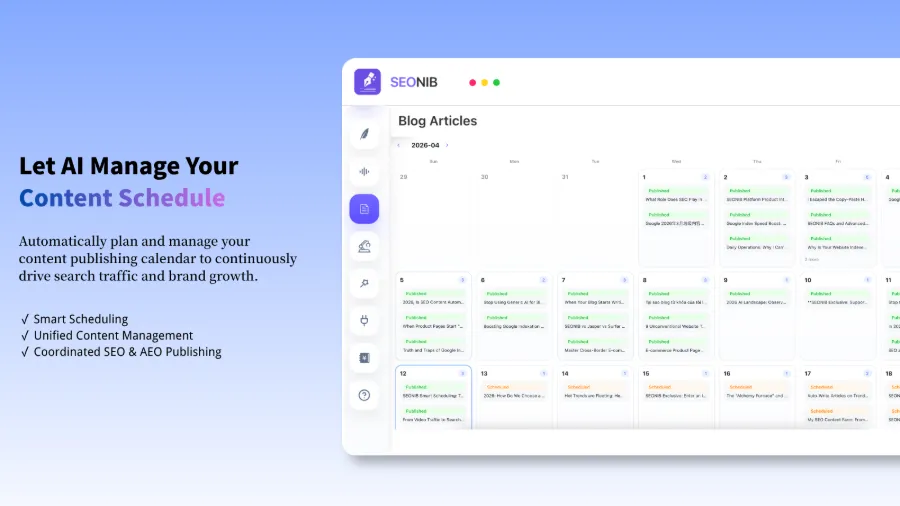
Having content isn’t enough; consistent publishing is key. I set a rhythm based on my site’s historical data: one post on weekdays, none on weekends. The AI automatically builds a calendar at that frequency, so at the start of each month I can see the entire publishing plan and make adjustments in advance. Once confirmed, the subsequent generation and publishing require no further touch from me.
Multi‑Platform Synchronization: Write Once, Appear Everywhere
After the content is created, manual distribution is the most easily overlooked hidden cost. The advantage of automation is that once an article is published, the system automatically syncs it to Shopify, WordPress, and other platforms, eliminating the need to log into each back‑end to copy‑paste. If you use Shopify for a standalone store, the sync logic can be directly hooked into your existing shop.
Shopify users can refer to the guide on converting social media links into blog posts to understand how content syncs from external sources to your store. Additionally, automated content can sync to e‑commerce systems beyond the official Shopify website, covering scenarios far broader than you might imagine.
Of course, the early stages of automation aren’t perfect. The generated titles were once overly templated—phrases like “X Ways to Improve Y” kept repeating. I later added trigger words and rewrite rules manually to improve them. Also, if you set the publishing frequency too high, low‑quality content piles up quickly, giving the site a “publish for the sake of publishing” vibe. A reasonable rhythm matters more than sheer quantity.
A Real Traffic‑Growth Case Study
Data doesn’t lie. I tracked a SaaS site for 45 days after deploying a fully automated content pipeline; organic traffic grew by 170%. The first two weeks showed almost no effect—the traffic curve stayed flat—then it started climbing in week three and clearly diverged from previous levels around week six.
This case mirrors my own experience. During the manual phase I wrote about 20 articles, with the highest monthly organic traffic under 500. In the third month after switching to automation, monthly organic traffic broke 1,500. While that number isn’t impressive for a large site, for a one‑person‑run SaaS site it represents a reproducible growth path.
If you still doubt automation’s impact, read this real story of a blog that drove search traffic. It confirms a simple conclusion: search engines reward not article quality but the cadence and relevance of updates.
I also discovered a less obvious phenomenon: automated content not only saves time but also keeps the site “active” in the eyes of search engines. Search engines lower crawl frequency for sites that haven’t updated for a long time, whereas continuous automated pushes constantly refresh the site’s freshness signal. Another finding is that SaaS audiences are mostly decision‑makers, and structured articles produced automatically (with clear headings and Q&A formats) are more likely to be captured and recommended by AI search tools like ChatGPT and Perplexity. This means you’re not only vying for Google rankings but also tapping into AI search traffic channels.
For detailed configuration and scenario‑specific settings, consult the SEONIB help documentation.
FAQ
Will automated content affect article quality?
It depends on your definition of “quality.” If you aim for each article to have a unique viewpoint or deep industry insight, automation can’t deliver that—it produces structured SEO material. But if your goal is to consistently generate usable content around specific keywords and cover long‑tail searches, automation works well enough. I usually spend ten minutes each week skimming next week’s drafts, deleting or rewriting obviously awkward paragraphs.
How many articles should be published per day?
For most SaaS sites, 1–2 posts per day is a safe rhythm. I initially tried three per day; after 20 days the indexation rate dropped because Google’s crawl bandwidth couldn’t keep up. Dropping to one per day restored normal performance. For a brand‑new site, start with 3–4 posts per week and gradually increase to one per day.
Is this automation applicable to all SaaS companies?
In theory, yes, but the type of content determines effectiveness. If your SaaS product benefits from documentation, tutorials, and industry comparison content for acquisition, automation works best. If your product relies heavily on brand storytelling or the founder’s personal influence for sales, automation may not add much value—its strength lies in scale, not uniqueness.
Will duplicate content be penalized by Google?
Automatically generated content isn’t the same as plagiarism. As long as you set reasonable rewrite rules and diversify sources, the system won’t produce identical articles. However, if you let the AI generate ten homogeneous articles from the same keyword, search engines will flag it as low‑quality content accumulation. The key is to give each article a different angle and source material.
Can any website use an automated content tool directly?
Yes. Many automation platforms come with built‑in site‑building features, so you don’t need an existing website. You can start with an empty domain and let the system build a content site from scratch. In the early stage, focus on accumulating article quantity and topic coverage; once traffic picks up, you can work on branding.
Share Article