After Google I/O 2026: SEO Isn’t Dead, It’s Just Been Split in Two
Three weeks after the 2026 Google I/O conference, I was staring at the steadily declining curve in Search Console. My first reaction, like many others, was: Is SEO over? More and more query terms are being occupied by AI answers, natural clicks are visibly shrinking, and the team has already started discussing whether to shift the budget to paid media.
But when you look at the data over a longer period, the conclusion is completely different. From the launch of AI Overviews in 2024 to the period around I/O 2026, AI search has indeed been crowding out natural clicks year by year, and the turning point happens to fall near each I/O conference. However, traditional search results have not disappeared; they have simply been pushed lower on the page. SEO isn’t dead; it has been split into two distinct yet interdependent halves: traditional search rankings and AI search citations. Both halves are essential—relying on only one is truly risky.
The I/O Conference That Split Search in Half
The signals released at the 2026 I/O conference were clear: the scope of AI answer coverage expanded further, and the traditional “ten blue links” are being continuously compressed in the visible area, but they have not left the stage. For independent site operators, this means that search traffic is now divided into two entry points—users may read an AI‑generated answer directly, or they may still click through to your page.
The differences between the two halves are clearer in the table below:
| Dimension | Traditional Search Half | AI Search Half |
|---|---|---|
| Who the content is written for | Crawlers and ranking algorithms | Language models and citation mechanisms |
| Core tactics | Technical SEO, backlinks, page authority | Structured Q&A, entity relationships, knowledge pages |
| Key metrics | Rankings, click‑through rate, organic traffic | Citation count, AI recommendation exposure |
| Content format | Long articles, product pages, blogs | Knowledge pages, FAQs, entity pages |
| Effectiveness timeline | Weeks to months | Faster, but depends on indexing foundation |
A often‑overlooked fact is that both halves rely on the same indexed content foundation. AI cannot cite a page that isn’t indexed—no matter how smart the model is, it can only extract facts and conclusions from content that is already in the index. Therefore, the claim “SEO is dead” doesn’t hold up; the real problem is that many operators focus all their effort on one half while the other half quietly loses opportunities. To verify this, see the practical notes on validating market demand with a minimal website, which records how a team quickly tested content strategy direction with limited resources.
Traditional Search Half: Technical Foundations Still Determine Survival
Indexing and crawlability are the common foundation for both halves. The prerequisite for AI search engines to cite content is that the page is indexed; the prerequisite for indexing is that crawlers can successfully fetch, parse, and understand your page. In 2026, technical SEO is no longer a differentiator that “adds points” but a baseline requirement—“if you don’t do it, you’re out.”
The checklist hasn’t changed much: don’t block key paths with robots.txt, keep the sitemap updated, avoid contradictory canonical tags, and don’t let Core Web Vitals drag you down, plus add structured data. However, priorities have shifted—2026 technical SEO checklists now list “structured data and parseability” as the top priority, rather than the page speed emphasis of recent years. The reason is easy to understand: models need to identify entities and relationships on the page, and structured data is the most efficient parsing path for them.
The recommended workflow is to first verify, then optimize: confirm the page is being indexed correctly, then address rendering and parsing issues, and finally consider speed and experience. A case study of a brand‑new site with no backlinks that succeeded by using the correct structure also confirms this point—without backlinks, a correctly structured site can still win opportunities from the start. Conversely, a counter‑example: an independent e‑commerce store that relied solely on traditional search rankings and technical details to maintain authority saw a noticeable drop in natural clicks within months as AI answers began to capture its core queries. It had no Q&A‑style knowledge page that AI could cite. Its technical foundation kept its indexing eligibility, but it lost its traffic.
AI Search Half: Content Is No Longer Written for Crawlers, It’s Written for the Model
The logic of this half is completely different. The core of AEO (Answer Engine Optimization) and Entity SEO is understanding how the model extracts facts and conclusions from a page. The model doesn’t read the whole text like a user; it prefers information from clearly structured, conclusion‑first, entity‑relationship‑explicit paragraphs.
Therefore, content must be written for model parsing: start with the answer, organize information in a Q&A structure, and make entity relationships explicit, rather than stuffing keywords into paragraphs. AI citations are becoming a new measurable exposure metric—you won’t see them in Search Console, but when an AI answer includes your brand name and link, that itself is a traffic entry point. Knowledge pages and entity pages are the main carriers for this type of referral traffic: a page that clearly explains “what it is,” “how to choose,” or “who it compares to” is far more likely to be extracted by the model than a generic industry overview.
For cross‑border e‑commerce, multilingual coverage dramatically increases the probability of AI citation. Adding another language expands the search surface that AI search engines can cover and cite; a multilingual system is a key lever for the AI search half. Another practical issue is that product pages are hard for models to cite directly because they lack a Q&A structure and conclusive statements. Converting product pages into model‑parsable blog content is a more viable path—see the detailed steps in the product‑to‑blog conversion guide.
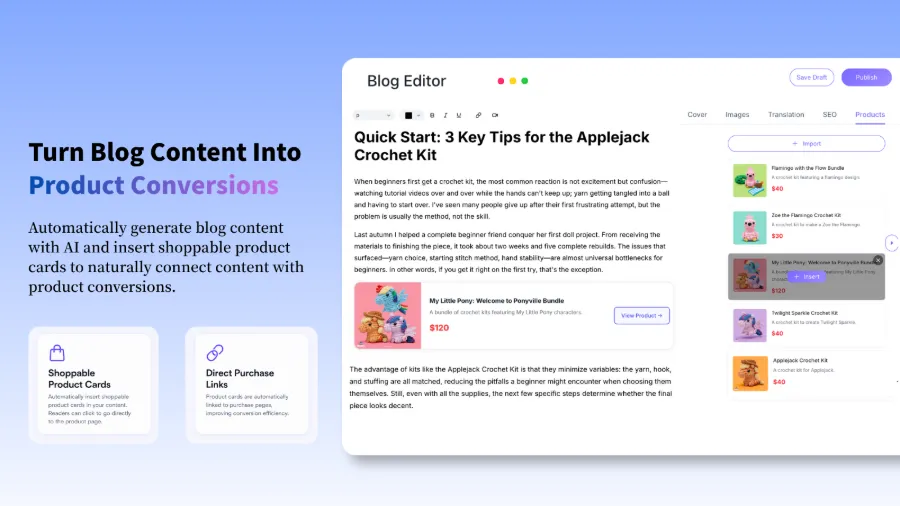
At this point, the real problem for operators surfaces: both halves must be done, workload doubles, where does the time come from? Fixing technical issues while producing content is impossible for a small team.
How Cross‑Border E‑Commerce Sellers Can Bet on Both Halves Simultaneously
Independent site teams are usually tiny, juggling manual dual‑track work—checking technical issues on one hand and writing content article by article on the other—quickly burns out. A practical approach is to build a content pipeline and hand the most repetitive steps to tools.
The pipeline consists of four steps: discover topics → generate content → schedule publishing → sync across platforms. Each step has its own pain points: topic discovery relies on news and competitor monitoring, content generation requires manual copying into the backend, publishing needs separate logins for each platform, and update frequency depends entirely on personal willpower. The publishing step is the most repetitive—one piece of content must be uploaded individually to Shopify, WordPress, SHOPLINE, etc., a fully manual process with no technical value that consumes massive time. Automating this step offers the highest ROI and is exactly where tools like SEONIB come in: they turn content generation, scheduling, and multi‑platform syncing into a single pipeline, rather than just solving the “write article” part.
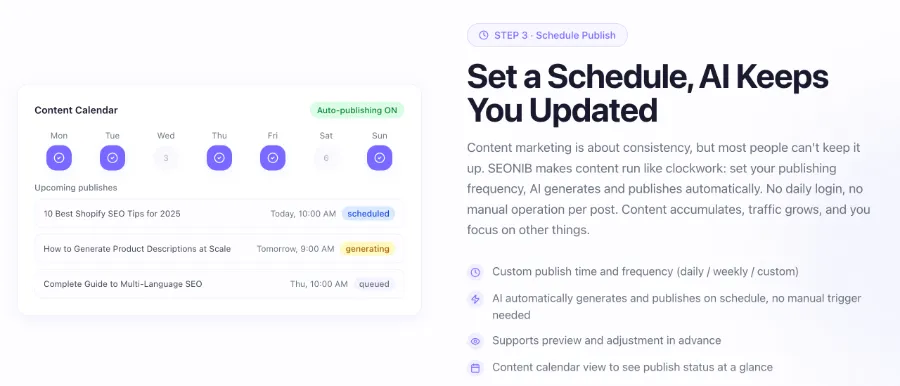
The value of the pipeline lies in consistency. Maintaining a steady update frequency and continuous accumulation applies to both halves—traditional search needs ongoing content signals to build topical authority, while AI search needs enough citable pages to increase the chance of being selected. After automation, a single publish syncs to all designated platforms, and update frequency no longer depends on personal will. SEONIB automatically syncs after publishing to Shopify, WordPress, SHOPLINE, etc., eliminating the per‑platform upload step—exactly the workflow highlighted in its Shopify App Store announcement.
Start by automating the most repetitive publishing step, then gradually take over content generation and scheduling. You can’t become an overnight success, but by outsourcing the most mechanical part first, the team can free up capacity for truly judgment‑heavy tasks—topic selection, content strategy, and entity coverage. Full operational steps are available in the help documentation, which breaks down the entire process from integration to launch.
FAQ
After Google I/O 2026, is traditional SEO still necessary?
Yes, and it’s a prerequisite for AI search. AI can only cite pages that have been indexed, and indexing depends on the technical foundations of traditional SEO—robots.txt, sitemap, canonical tags, structured data. Abandoning traditional SEO means abandoning both halves, because AI search builds on top of it.
Will AI search preferentially cite my own site’s content?
Not automatically, but you can increase the likelihood. Clearly structured Q&A pages, entity pages, and knowledge pages, combined with structured data, are the content formats that models find easiest to extract. Multilingual coverage also significantly expands the search surface that can be cited.
My small e‑commerce team has limited time— which half should we tackle first?
First, preserve the technical foundation of traditional search to ensure pages are indexed, then invest in AI‑search content. If time is extremely limited, prioritize automating the publishing step—it’s the most repetitive and least judgment‑dependent, freeing up time for content strategy.
What’s the real difference between AEO and traditional SEO?
Traditional SEO optimizes for rankings and clicks; content is written for crawlers and algorithms. AEO optimizes for the probability of being cited in AI answers; content is written for language‑model parsing. The former looks at rankings and organic traffic; the latter looks at citation count and AI recommendation exposure. Both share the same indexing foundation, but the content formats and metrics differ completely.
Share Article