
Turning SEO Content into an Unattended Assembly Line

During the day I open five or six tools, copy keyword rankings, backlink data, and technical audit results into a spreadsheet, and assemble a weekly report — I’ve been doing this workflow for nearly three years. In the evening I still have to log into the site backend and manually publish the articles I wrote during the day, filling in meta tags, adding images, and adjusting formatting. By 2026, the real bottleneck in SEO is no longer a lack of tools; it’s the sheer number of tools and scattered data, and the chain from “topic discovery” to “content publishing” has never been linked together. Whoever automates this chain first will reap the information asymmetry dividend.
The daily routine of content operations shouldn’t be data shuffling. The real time should be spent on judging whether a topic is worth pursuing and how to position the content, not hopping between a dozen backends.
Why More Tools Slow Down Content Production
I currently maintain three independent sites, each equipped with a different set of tools. Ahrefs for backlinks, SEMrush for competitor analysis, SE Ranking for rankings, Nightwatch for fluctuations. It sounds professional, but in practice it’s another story — each tool has its own data definitions and export formats, and aligning the time dimensions and metric definitions for a cross‑tool report takes more than half a day.
I recall a statistic: marketers spend up to 40% of their weekly work time organizing data rather than executing. This ratio is accurate for me, perhaps even higher. Even more problematic, most of these tools are still built around the traditional SERP and respond slowly to changes in AI search engines and generative results. I watch a keyword slip from rank 3 to rank 15 in the rank‑tracking tool, but I can’t tell whether it’s a content issue or AI Overview taking the spot.
The overhead of switching between multiple tools is larger than imagined. Everyone interprets the same data differently, and half the meeting time is spent debating “which tool’s data is more accurate”. I later compiled my own approach, written in the AI SEO Guide and Automation Strategy, whose core message is: the value of tools lies in reducing decision‑making cost, not adding data noise.
Deconstructing the Content Production Pipeline: Which Steps Are Worth Automating
When you break down SEO content work, there are roughly five stages: topic discovery, article generation, SEO layout optimization, scheduling and publishing, and multi‑platform synchronization. I once tallied it: an article with images, filled‑in SEO info, and then distributed to three platforms requires over forty steps of repeated logins and manual entries. The only parts that truly demand brainpower are topic judgment and tone control.
Article generation has largely been solved by AI tools in recent years; ChatGPT and Claude can both produce structurally complete drafts. However, there remains a lot of repetitive manual work between generation and publishing — adding images, adjusting formatting, filling meta tags, uploading to each platform. These steps can be handed over to tools; platforms like SEONIB aim to eliminate the gap between topic selection and publishing, allowing an article to go from creation to live without my presence.

I’ve seen many teams stuck in the state of “content can be written but not published”. Articles sit in the drafts because no one has time for formatting and publishing. Understanding this through the logic of a simple website to quickly validate whether a project idea has a market makes sense — a content site can first get the publishing pipeline running, then worry about the quality of individual pieces.
Replace “Write Whatever Comes to Mind” with a Stable Supply of Topics
The core reason for content gaps is often not an inability to write, but nothing to write about. In reviewing my own content sites, any period of a week or more without updates was almost always because I opened the editor that day and didn’t know what to write.
Later I turned the topic selection mechanism into a system‑driven process. AI continuously tracks industry trends, competitor content, and keyword search volumes, automatically pushing a batch of topics with traffic potential assessments into the topic pool each day. I just pick the appealing ones and convert them into writing tasks with a single click. This change solves not “how well it’s written”, but “whether there’s something to write”.
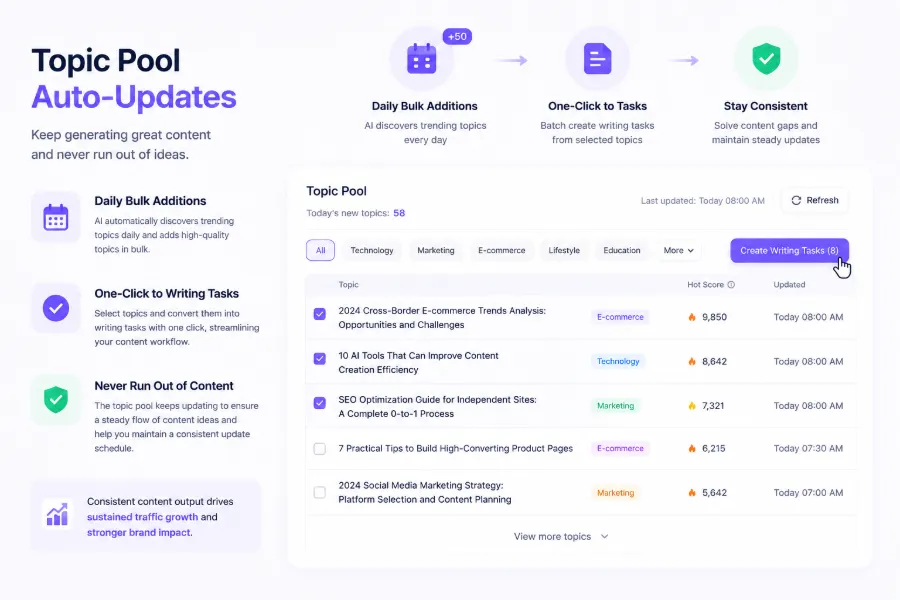
I have an independent content site that relies solely on blogging for search traffic; the key to early growth was not writing skill but topic rhythm — it maintained a steady output of three articles per week, and the crawl frequency and authority accumulation of the search engine rose accordingly. I documented this in A Practical Record of Gaining Search Traffic Through Blog Content, whose conclusions align with my own experience: solving the “content gap” issue itself contributes more to the accumulation of search authority than the traffic value of a single viral post. I also compiled a framework explaining how content supports AEO, which later repeatedly validated a point — the SEO meta information and structured layout of a publishing page significantly affect subsequent recommendation and indexing by AI assistants like ChatGPT, yet this is often severely underestimated. Once this topic mechanism runs smoothly, SEONIB’s automatic push becomes my first task each morning: glance at today’s suggested topics, discard the unsuitable ones, and hand the rest over to the system.
Multi‑Platform Publishing and API Integration: Closing the Last Manual Loop
After automating topic selection and generation, the last manual step is publishing. My sites are on WordPress, Shopify, and Shopline backends; each publication requires separate logins, pastes, image uploads, and SEO settings. Distributing the same article to four platforms yields a time difference of about forty minutes per release between manual and automated workflows.
The value of Webhooks and HTTP APIs lies in connecting CMSs and proprietary systems that lack pre‑built integrations. The API integration management page allows configuring various push rules; a single publish automatically pushes the content to all designated platforms.
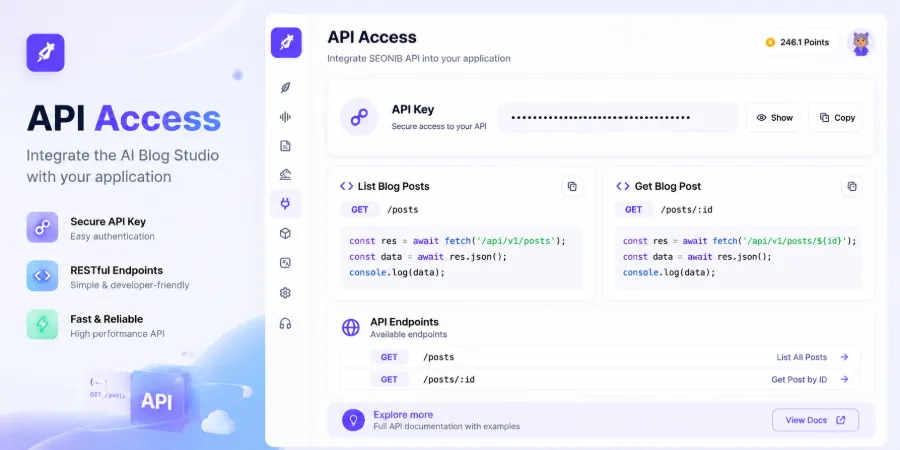
But automation does not mean abandoning everything. In an e‑commerce independent site project, I manually updated daily for three months to chase trends; after a two‑week pause, traffic immediately dropped. That lesson taught me that a frequency maintained by willpower is unsustainable; stability must come from systems, not self‑discipline. So even though publishing is now fully automated, I still spend half an hour each week manually reviewing the topic and schedule preview, ensuring brand tone and content direction are vetted. The operational details of the entire publishing mechanism are in the help documentation. Specific API integration configurations can be found in the HTTP API Push and Integration Guide.
In a generative search environment, site structure and the quality of continuous updates determine whether AI will recommend your content. For this direction, How to Make ChatGPT Treat Your Site Like a Treasure explains it clearly. My experience is that the feedback cycle of search results is lengthening; after publishing, you cannot look only at same‑day data but must continuously monitor the trend of Search Visibility, rather than being swayed by single‑day fluctuations.
FAQ
Will AI‑generated bulk content be flagged as low quality by search engines?
Yes, but only if the content hasn’t been manually calibrated. After more than six months of testing, articles that were generated and published directly had a noticeably lower indexing rate than content that went through topic selection, structural fine‑tuning, and a fact‑check and brand‑tone alignment. Adding proper meta tags and structured data further reduces the chance of being deemed low quality.
Do automatically published articles still need a manual rewrite?
Yes, but not on a per‑article basis. My current practice is to set aside a day each week to batch‑review the content slated for that week, focusing on whether topics deviate from brand direction or contain factual errors. The wording and formatting of individual pieces are left to the system; humans only provide directional oversight, reducing the time spent on each article to a few minutes.
Is an automation workflow worthwhile for a single‑person small site?
Yes, but you need to be clear about the goal of automation. I’ve seen many single‑author sites die due to content gaps; automation solves the problem of sustained output, not a sudden traffic surge. If you can accept a slow traffic climb in the first three months, an automation workflow can help you increase your publishing frequency with the same effort, and the speed of accumulating search authority will be noticeably different.
Share Article