
Content Freshness: Key Signals and Operational Guide for AI Citation Rates
It took me more than half a year to confirm one thing: the AI citation system’s judgment of freshness is completely different from the traditional SEO definition of a “new article.” In early 2025 I updated a 2022 pricing comparison article, changed the title and a few pieces of text, waited two weeks, and checked Perplexity’s citation log— the citation rate hardly changed. The second time I completely replaced all data sources, added a 2025 market price table, and added a “as of Q3 2025” prefix to the title, and only after two weeks did it appear in AI answers. This process proved that superficial updates are merely futile.
When AI search engines select citation sources, they don’t look at whether your page “looks new”; they look for reliable temporal signals. An article published in 2021, even if its publication date is altered, will still be preferentially fetched by LLM retrieval systems if its body clearly marks “as of April 2026.” This is no longer a simple SEO trick issue but a complete content operation logic.
Why LLMs Care About Content “Freshness”
Content freshness is a quality signal that measures whether information reflects the most current and accurate state, typically judged by publication date, last modified time, update frequency, and the recency of cited data. For traditional SEO, Google’s QDF (Query Deserves Freshness) algorithm already gives higher weight to fresh content for timely queries. However, LLM evaluation logic differs: large language models have a knowledge cutoff, while RAG systems (such as Perplexity, ChatGPT Browse, Gemini) pull web content as context at runtime, relying on timestamps to reduce the chance of citing outdated data.
A often‑overlooked fact is that the turnover rate of “top‑brand” results in AI citation systems is extremely high. According to Writesonic’s public data, 52 % of top‑brand AI search results are replaced within a year—this isn’t because their content quality declines, but because competitors that update more frequently gain AI system favor. When an LLM needs to verify the timeliness of a piece of information, it preferentially fetches pages with explicit temporal anchors, ignoring content that updates frequently but without substantive change.
Which Content Areas Depend Most on Freshness
Not all content requires high‑frequency updates. The table below shows the distribution of freshness sensitivity I’ve observed in my own operations:
| Content Category | Freshness Sensitivity | Reason |
|---|---|---|
| Pricing & Plan Comparisons | Very High | Prices change quarterly; stale prices erode trust |
| Software Feature Comparisons | Very High | Product updates are frequent; LLM flags outdated specs |
| Statistical Summaries | High | Cited data must be verifiable with dated sources |
| How‑to Guides | Medium‑High | Tool UI changes reduce step accuracy |
| Regulatory Content | High | Rules change often; stale advice creates liability risk |
| Evergreen Conceptual Content | Low‑Medium | Core definitions change slowly; minimal freshness pressure |
Pricing content is the area where I’ve hit the most pitfalls. When comparing Shopify plans, if you write a 2024 pricing table and still use it in Q3 2025, the AI retrieval system will skip your page and fetch the competitor’s newer data. You can directly verify the latest plans on the Shopify website, which is the fixed data source I use when updating pricing comparisons.
Software feature comparisons are similar. Tools release new features quarterly or even monthly; if the AI system detects that a page’s version number or screenshots are clearly outdated, it deems the source unreliable. How‑to guides have moderate‑to‑high sensitivity, but failing to update UI screenshots and step order still affects citation rates.
How AI Systems “Detect” Freshness Signals
LLMs don’t skim the beginning of your article like a human editor to judge age. They read temporal information through structured and unstructured signals:
HTML meta tags article:published_time and article:modified_time are the most direct signals. In JSON‑LD structured data, the dateModified field of a Schema.org Article lets crawlers and retrieval systems accurately recognize the last substantive update. Temporal references within the body are also crucial—phrases like “as of Q2 2026” or “updated 2025” give the AI system explicit time anchors.
The recency of citation sources is another underestimated signal. For example, Gemini’s SEONIB feature breakdown case shows how the AI system judges whether the cited data source itself is outdated. If one article cites a 2019 report while a competitor cites a 2025 equivalent, the latter’s citation rate will be noticeably higher.
Crawl frequency also plays a role. Pages that receive regular traffic and inbound links are crawled more often by search engine bots, providing the retrieval system with fresh snapshots. However, this presupposes a “substantive update”—changing a title or fixing a typo is meaningless to AI. Data replacement, new sections, removal of false statements, and adding inline timestamps are the key actions that trigger changes in citation probability. For more detailed structured implementation, refer to our help documentation.
Returning to the failed case: I only changed the title and a few sentences of the pricing article, without replacing any data sources or adding new timestamps. The AI retrieval system saw a 2022 article with 2022 data and a new title—naturally, it did not increase citation weight.
Systematic Execution of Content Freshness Updates
After many repeated experiments, I now fix the update process into three layers. First, replace outdated data sources. For every statistic, market report, or official figure, find the latest version and attach a new source link. Second, add new sections to cover missing issues. User comments, new version release notes, industry changes—these are sources of fresh content. Third, insert inline timestamps so the AI knows the temporal anchor for each key piece of information.
Updating an old page is far more cost‑effective than publishing a new article. Old pages already have external link equity and domain trust; after updating, the AI retrieval system is more likely to cite them than a brand‑new article with zero authority. I’ve run comparative tests: for the same keyword, the AI citation rate of an updated page grows more than twice as fast as that of a new page.
This is where workflow automation comes in. When I tried to manually maintain the update cycle for over 20 high‑sensitivity pieces, it became impossible after two months. I evaluated several tools and ultimately used SEONIB’s scheduled publishing and bulk update features to keep the rhythm.
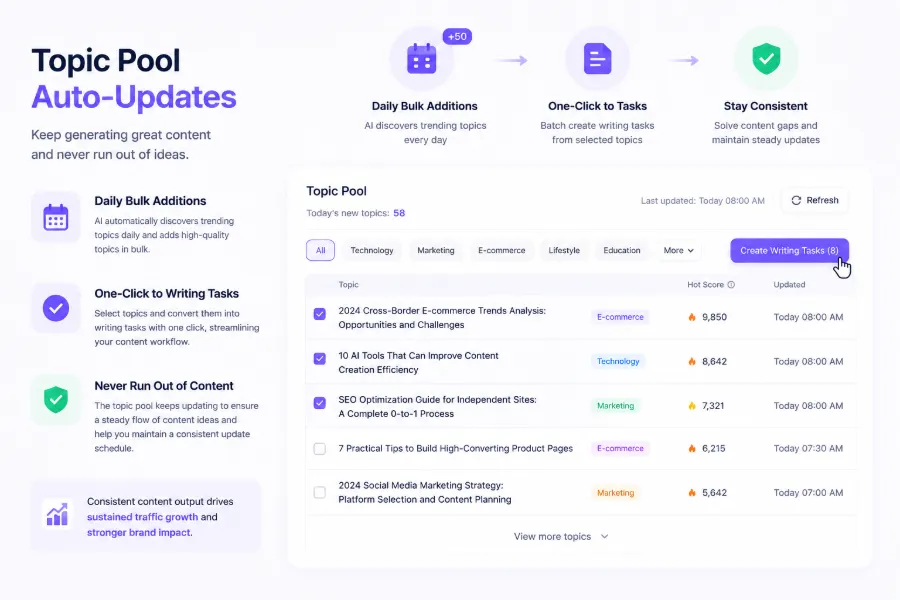
Systematic topic management makes the update cadence predictable. If you face similar content maintenance challenges, check out our AI Agent automatic publishing guide, which shows how to lock the update process into automated tasks. SEONIB’s scheduled publishing lets me set weekly or monthly update plans; the AI generates new versions and publishes them automatically, eliminating daily manual checks for content that needs refreshing.
The core value of scheduled publishing and bulk updates isn’t just time saving; it’s maintaining a stable update frequency—an essential metric for AI systems to deem a site an “active source.”
Measuring Whether Freshness Updates Are Effective
If you don’t track results after updating, you’re making decisions in the dark. Every month I monitor AI citation frequencies with Writesonic, checking which pages appear in Perplexity and ChatGPT answers and which remain unchanged. Citation rate changes, crawl frequency changes, and traffic changes are all indispensable metrics.
The video showing a blog syncing to Shopify is essentially a real‑world case of rapid distribution after content updates. If updated content isn’t quickly indexed and delivered to users, the value of freshness signals diminishes.
I must be honest: freshness alone does not guarantee citations. I had a how‑to guide updated three times, with completely correct information and clear timestamps, yet its AI citation rate stayed low. The issue turned out to be insufficient topical authority—Google search results didn’t rank it in the top three pages, so the AI system naturally didn’t prioritize it. Fresh, structured, and authoritative content are all required.
Content operation is tedious, but one thing is certain: continual updates, leveraging automation tools, and monitoring citation feedback create a loop that can generate AI traffic without a marketing budget. If you’re unsure where to start, begin with high‑sensitivity categories (such as pricing comparisons) and validate results over a month. For a more systematic framework, our AI SEO guide may be a better starting point.
FAQ
Does content freshness only affect AI citations?
Not entirely. Freshness also influences traditional search engine rankings, especially for time‑sensitive queries. However, AI citation systems are more sensitive to temporal signals because LLMs need timestamps to reduce the risk of outdated answers.
When updating content, should I modify the URL?
Do not change the URL. Keeping the original URL preserves existing external link equity and indexing history—advantages a new page cannot replace. Just update the content itself and sync the last modified timestamp.
How often should content be updated to maintain freshness signals?
It depends on the content type. Pricing content should be fully updated quarterly; how‑to guides should check tool versions every six months. The key isn’t a fixed frequency but ensuring each update involves data replacement or new sections, not merely a title change.
For AI citations, is updating an old article more effective than publishing a new one?
Updating an old article is usually more effective. The old page already has domain trust and inbound links; after updating, the AI retrieval system more easily recognizes it as a “verified + currently usable” source. A new page must build those signals from scratch, which takes longer.
If my content focuses on evergreen topics, do I still need to pursue freshness?
Yes, but the pressure is much lower. Core definitions in evergreen content change slowly, but if the external data sources you cite (e.g., Wikipedia or official reports) are updated, your page may be considered outdated by AI and lose citations. It’s advisable to verify all cited sources at least once a year.
Share Article