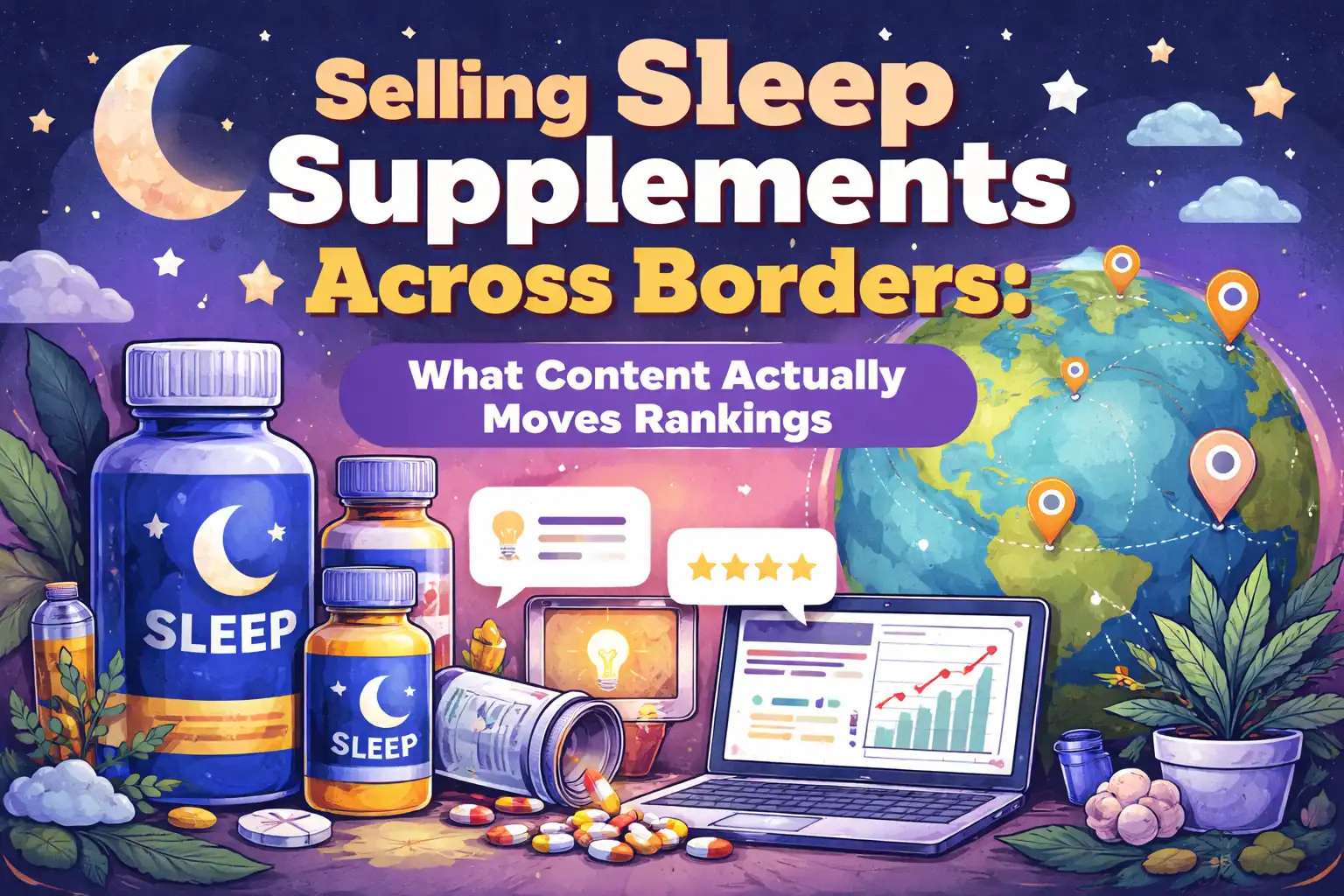
Selling Sleep Supplements Across Borders: What Content Actually Moves Rankings
I run a small ecommerce store that sells sleep supplements—melatonin gummies, magnesium glycinate, a few herbal blends with ashwagandha and valerian root. The store ships to about fifteen countries now, and for the first year I thought the hard part would be logistics. Customs duties, labeling requirements, payment methods. That part was hard, but manageable. The part that nearly killed the business was content.
When you sell a physical product like a sleep supplement, your product pages are the floor. People land on them after searching a brand name or a specific ingredient. But for most of my traffic—the people who type “best supplements for sleep” or “magnesium for insomnia reddit” into Google—those pages never appear. The rankings come from articles, guides, and FAQs that answer the questions people actually ask before they even know which brand to buy. The best supplements for sleep are those backed by clinical evidence and tailored to individual needs, but in ecommerce, winning the search results requires structured, localised content that answers real customer questions across every market you enter.
I learned that the hard way after spending three months writing fifteen articles in English, only to see Search Console showing zero impressions from Germany or Japan. The content was decent, but it wasn’t speaking the right language, and it wasn’t laid out the way Google wanted.
The Content Pipeline Nobody Warned You About
The first six months were manual. I would wake up, check forums and social media for trending sleep-related questions, then sit down to write a 1,500-word article about, say, how melatonin affects jet lag. I’d open ChatGPT, paste a prompt, copy the output into WordPress, tweak it, add images, fill in meta descriptions, then copy-paste the whole thing into my Shopify blog. One article took about three hours. If I wanted it in Spanish or French, I’d run it through DeepL, then manually adjust the SEO metadata because the translation butchered the title tags.
I could manage two articles a week. That’s maybe eight per month. For a store targeting five languages, that meant each language got roughly 1.6 articles per month. You don’t build authority at that pace. I knew it, but I didn’t have a better option.
The frustration peaked when I noticed a competitor—a German store selling basically the same magnesium product—had 80 indexed articles in German alone. They were ranking for every long-tail variant: “magnesium bisglycinat schlaf einnahmezeitpunkt”, “magnesium gegen durchschlafstörungen”. My store had exactly zero German-language articles. I couldn’t hire a translator or a local content writer at €50 per article for 80 pieces. The math didn’t work.
When Automation Actually Made Sense
I started looking for content automation tools that could handle the full pipeline—topic discovery, writing, SEO formatting, and multichannel publishing. I tested a few, but most required me to still copy-paste between systems or manually approve every piece. The one that stuck was SEONIB, mainly because it connected directly to my Shopify store and could take a product link and turn it into a structured buyers’ guide without me having to touch the backend.
The workflow I settled on was this: I’d take my top-selling magnesium glycinate product and paste its URL into SEONIB. The tool would pull the product details, then generate a 1,200-word article titled something like “Magnesium for Sleep: How Much to Take, When to Take It, and What to Look For.” It added an FAQ section with JSON-LD schema, internal links to related products, and a meta description that didn’t sound like spam. I could preview and edit before publishing, which I always did because the first few drafts contained a few too many generic sentences. After a week of tweaking the prompts and tone settings, the output became usable enough to publish with light editing.
The first article went live on a Tuesday. Within two weeks, it was ranking on the first page for “magnesium glycinate sleep dosage” in English. That specific query had about 400 monthly searches—not huge, but it drove a steady trickle of clicks from people already close to buying. More importantly, it gave me the confidence to scale.
Cross-Border Content: The Real Test
Setting up automated content for English was straightforward. The real test was localisation. SEONIB supports forty languages, so I configured pipelines for German, French, Spanish, and Japanese. I set the tone to “informative but relaxed”—sleep supplement readers don’t want clinical jargon, but they also don’t want fluff. The tool generated articles using local currency references, regional measurement units, and culturally appropriate terminology. For example, the German version of the melatonin article used “Einschlafstörungen” instead of the generic “Schlafprobleme” because that’s the more common search term.
I published three articles per week per language. After three months, I had roughly 180 articles across five languages. The German store started showing up in Search Console for the same queries my competitor was ranking for. Traffic from non-English markets went from near zero to about 35% of total sessions. That was the biggest operational win.
But it wasn’t smooth. The Japanese translations had to be manually reviewed because the AI sometimes used the wrong politeness level—keigo for a product description reads oddly. I also had to adjust the FAQ answers to avoid making medical claims that would violate local advertising laws. In the EU, you can’t say “treats insomnia” without a health claim approval. SEONIB’s output leaned toward safe phrasing, but I still had to delete a few sentences that suggested curative effects. That took about two hours per week of overhead—manageable, but not fully hands-off.
The Compound Effect of Consistent Publishing
After six months, the article count crossed 200. I stopped checking Search Console daily because the daily impressions had climbed from a few hundred to over 8,000. The traffic wasn’t evenly distributed—English still dominated, but German and French had become meaningful second and third markets. A surprising side effect was that the automated internal links between articles improved the crawl budget usage. Googlebot started finding new pages faster because every new article linked to at least three existing ones.
I should mention that not every article performed. About 20% of the auto-generated pieces sat on page two or three with minimal traffic. The topic discovery feature sometimes suggested keywords with high search volume but low commercial intent—things like “can you overdose on melatonin” had traffic, but the people searching that were likely looking for a medical answer, not a product to buy. I learned to filter those out manually. The tool learned from that filtering over time, adjusting its keyword suggestions, but I still prefer to scan the topic queue once a week.
Another issue was cannibalisation. When you publish 200 articles in the same niche, you inevitably write about overlapping themes. “Best time to take magnesium” and “Magnesium at night” are close enough that Google sometimes couldn’t decide which to rank. I lost a few positions because the wrong article got the click. I fixed that by consolidating some articles and adding canonical tags, but it wasn’t a one-time set-and-forget thing. It required periodic audits.
FAQ
How many articles per week should I publish for a cross-border supplement store?
Three to four per language per week is a sustainable minimum. That gives you roughly 12–16 articles monthly per language. At that pace, you can build a visible content footprint in six to eight months, especially if you target long-tail questions with low competition. For sleep supplements, queries like “melatonin vs magnesium for sleep reddit” or “ashwagandha for sleep dosage” have modest volume but strong purchase intent.
Will automated content get penalised by Google for being AI-generated?
Not if you edit and validate before publishing. Google’s guidance on AI content is consistent: it penalises spam, not the method of creation. I run each article through a quality check—delete generic filler sentences, add a proprietary observation (e.g., “Our customers report better results with the glycinate form than with citrate”), and verify that the FAQ schema is valid. That takes about ten minutes per article. Articles published without that step performed worse, so don’t skip it.
How do you handle supplement regulations in different countries when auto-generating content?
I configure the tone setting to avoid making health claims—no “cures insomnia” or “treats anxiety.” Instead, use phrasing like “may support relaxation” or “can be part of a healthy sleep routine.” For the EU, I added a custom instruction in the tool’s context field: “Never state that this product diagnoses, treats, cures, or prevents any disease.” For Japan, I manually review because the regulations around “quasi-drugs” are stricter. It’s not fully automated, but it’s faster than writing from scratch.
What’s the typical ROI timeline for content-driven traffic?
First meaningful organic traffic from new articles usually appears within three to five weeks for low-competition keywords. The real compounding starts around month four, when older articles gain authority and start ranking for broader terms. My store went from $2,000 monthly organic revenue to about $11,000 over eight months. Content cost per article was roughly $4–$5 with the automation tool plus my editing time. The math works out, but you can’t expect results in the first month.
Share Article