
My Real Workflow for Solo SaaS Content Operations: How to Keep Steady Updates Without a Content Team

Lacking a content team doesn’t mean your content plan has to stall. Over the past six months, I’ve been using a solo workflow to maintain a weekly update cadence for a SaaS blog. This article breaks down the structure of that system—from topic selection and generation to publishing—without relying on multi‑person collaboration, just tools and process design.
If you’re also an independent operator who wavers daily between “what should I write” and “I just can’t write anymore,” this article might be the operational manual you need. Content automation isn’t laziness; it’s paving the road for yourself before fatigue sets in.
First, Acknowledge One Thing: For a Solo Content Creator, the Biggest Enemy Isn’t Creativity, It’s Fatigue
In solo content operations, the industry circulates an unglamorous yet factual statistic: over 60% of personal blogs cease updating within the first three months. It’s not a lack of material to write, nor is it that the output is of poor quality—it’s simply that the creator gets exhausted.
You open a dozen tabs daily to browse topics, manually copy content from notes to the backend, log into each platform, adjust formatting, add images, fill SEO metadata. After three weeks, the topic sheet starts gathering dust. In the fourth week you tell yourself “I’ll pause this week,” and then nothing follows.
The core issue of this cycle isn’t willpower; it’s operational burden. Solo operators daily face not a creative problem of “I can’t write a good article,” but execution fatigue of “I have to repeat the entire process again.”
So my first lesson is: without a designed process, fatigue will knock on the door right on the third week. It’s not your enemy; you just didn’t prepare for it.
Topic Selection and Content Planning Without a Team: Keeping the Direction on Track
Topic depletion is another vicious cycle for solo operators. Every day you open Google Search Console and see no traffic growth; then you open the topic sheet and notice each title feels like a repeat of yesterday, making you reluctant to open the file.
I tried manually using Ahrefs and SEMrush to run keyword libraries and maintain an Excel topic sheet. The first two weeks felt fresh; by the third week updates started slipping. By the fourth week, most entries left in the sheet were topics I wasn’t sure I could write about, but I also didn’t have time to verify.
Later I began using SEONIB’s automatic trend discovery to take over the topic queue. The system mines new topics daily from industry trends, keyword search volume changes, and social media hotspots, pushing them into the topic queue. Once set up, each morning I open the content calendar and the day’s publishing schedule is already laid out.
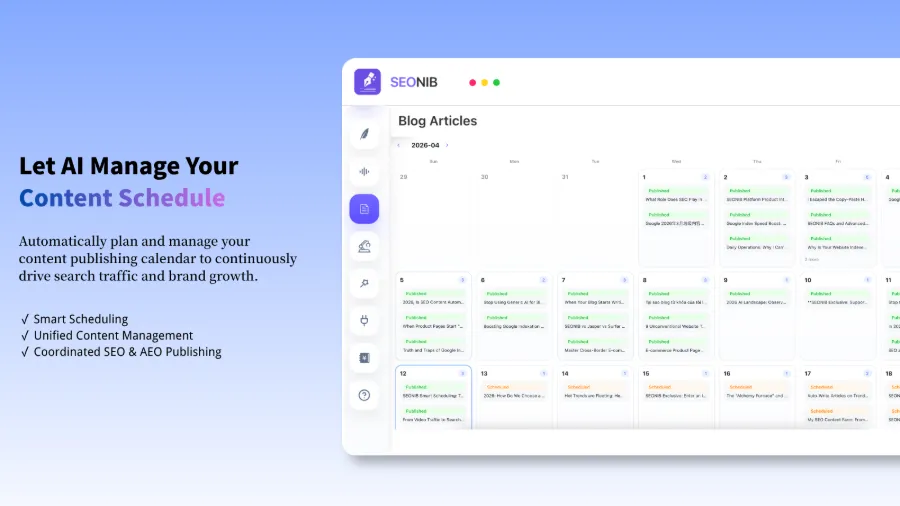
Unlike manually maintaining a topic sheet, this queue has a built‑in traffic potential scoring and keyword evaluation logic—automatically filtering out topics with low search volume or overly fierce competition, so you don’t waste time judging “I think this could go viral.” The system pushes roughly 24 new topics into the queue each day; I just pick the most appealing one, click, and the content moves into the generation stage.
A content creator’s “cheat sheet” notes that letting AI run trend discovery first is more efficient than manually scrolling social media daily, and it won’t miss non‑hotspot but search‑demand long‑tail keywords.
If you’re interested in the logic behind this automated topic selection, you can first watch this video demo—after entering a keyword, AI automatically discovers and pushes topics, which is indeed much easier than browsing a topic sheet.
Solo Creation Process from Zero to Publish: I Spend Only 15 Minutes a Day on Content
Without a team, it used to take me at least two hours from selecting a topic to publishing an article. This step is the real paradox for solo operators: if you have time to write, you have no time to promote; if you have time to promote, you have no time to write the next piece.
Now I limit the time I spend on “creation” each day to about 15 minutes. What do I do in those 15 minutes? Choose a topic, verify that the automatically generated draft has no obvious factual errors, check that the SEO title and meta description have no logical issues, then click publish.
Sounds simple, but broken down at the operational level, it looks like this:
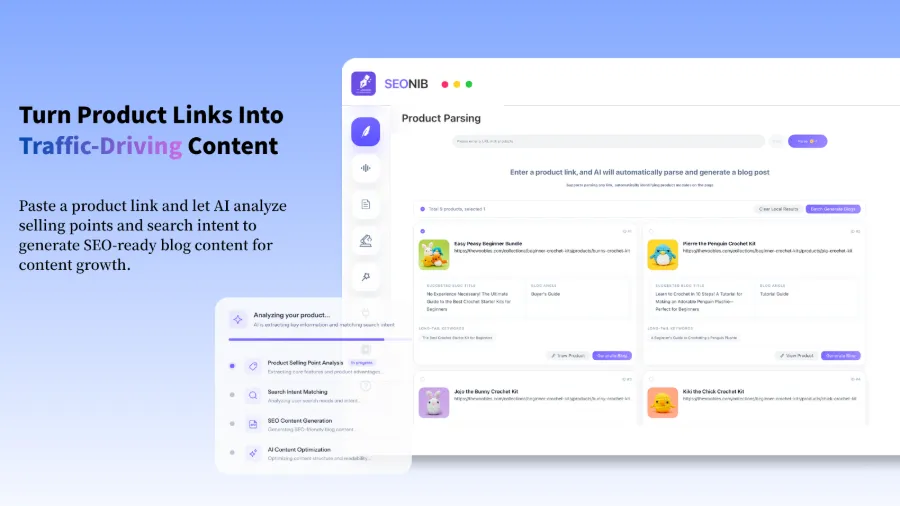
I use three modes:
Keyword to Blog – the most common. Input a core word, and the system automatically generates structure and content based on search intent and current ranking data. SEO optimization and internal linking are built‑in, no need to manually adjust meta. For cross‑border e‑commerce, you can generate a buying guide or review directly from a product link without having to design the article structure from scratch.
Social Post to Blog – a good method for supplementing traffic. If I post a video on YouTube or share content on Twitter, clicking “Social to Blog” converts it into a blog post that search engines can crawl and index. This feature completely solves the problem of content being scattered across platforms and invisible to search engines.
After one‑click generation, the system automatically adds images, fills SEO tags, and standardizes formatting—this is the key node that saves manual transfer time. To understand the best starting point for a solo content plan, see this overview of SEONIB’s overall architecture.
Currently this workflow supports 40 languages, so if you’re targeting a multilingual market, you don’t need to build a separate writing process for each language.
Automated Maintenance and Troubleshooting: Once Content Runs, Humans Only Handle Exceptions
After content goes live, the real maintenance pressure begins. The most overlooked task for solo operators is “keeping content continuously updated.” Search engines favor sites that update consistently (even with medium quality) by assigning better crawl rates, rather than sites that occasionally publish a perfect article and then stay silent for three weeks.
That’s the value of a scheduled publishing mechanism.
Set a publishing frequency, such as three per week or one per day, and let AI execute the rest according to schedule. You don’t need to log in daily to confirm content placement. The system automatically generates, formats, and publishes, synchronizing to multiple platforms. One publication covers all target platforms—Shopify, WordPress, Medium—without logging in and uploading individually.

The screenshot above comes from a Shopify seller who used SEONIB for three months. Initially about 800 impressions, after three months it approached 12,000. It’s not explosive growth, but a steady climb that provides a small team with predictable SEO expectations.
Of course, automation isn’t perfect. I must acknowledge a lesson here:
Early on, I overestimated the AI tool’s capabilities and set a daily automatic publishing frequency of six articles. After three weeks, the content suffered severe topic duplication and structural collapse— the same keyword generated three versions, and internal linking logic became a mess. I had to manually roll back the schedule, spending a weekend reviewing each piece, deleting duplicates, and resetting the publishing cadence.
After that, I reduced the publishing frequency to three per week and added a rule: each generated topic must be previewed and confirmed once; if it fails, it isn’t published.
The monitoring feature of the content calendar comes in handy here. You can see on the calendar which content is live, which is waiting in the queue, and which may have sync issues. If a platform upload fails (e.g., Shopify’s API suddenly goes down), the system doesn’t pretend it’s unaware—there will be a clear status marker on the calendar, and you only need to address that specific issue without redoing the entire workflow.
Learning to generate SEO blogs directly from product links, you can see the full steps at this link; using it together with the content calendar markedly improves efficiency.
If you encounter sync anomalies or want to verify a configuration, the full operation guide can be found here—a help entry that was the first thing I opened after a problem arose.
When SEO automation reaches its final stage, humans step back to the “exception handling” role. Image load failures, changes to a platform’s sync interface, content templates needing adjustments for new search trends—these are the actual workloads, not “the laborer producing each article.”
FAQ
Running a content blog solo—do I really not need to manually write each article?
You don’t have to hand‑write each piece, but you need to intervene for verification and scheduling. Automatically generated content doesn’t replace your judgment; it takes over repetitive physical tasks—topic search, formatting, image addition, SEO parameter filling. You just need to ensure the direction and content logic stay intact; the rest is handled by the process.
My industry is very niche—can AI find suitable topics?
Yes, but effectiveness depends on the breadth of context you provide the system. Niche industries have low search volume but very clear user intent. The trend discovery mechanism filters directions based on keyword search volume and competition, so even niche sectors can uncover topics with genuine search demand.
If I hire people later, can this workflow be transferred?
Yes. The entire workflow is based on operation permissions and task queues, not personal memory. New members just need to get familiar with the content calendar and confirmation process; they don’t need to rebuild the infrastructure. The bottleneck in solo operation is stamina, not ability. After hiring, this system will help shorten the onboarding period for newcomers.
Will automated content be considered low‑quality by search engines?
Search engines evaluate whether the content itself provides valuable information, not whether the generation process involved human input. The system includes built‑in SEO formatting, entity coverage, and semantic structure rules; generated articles typically have higher information density and entity relevance than pages filled haphazardly by humans. Quality issues mainly arise from topic duplication and uncontrolled publishing frequency—both can be managed by humans adjusting the rhythm.
Share Article