
Is there still an opportunity for SEO in 2026? In‑depth analysis of future search engine optimization trends

At the beginning of 2025, I took over an old site: daily organic search traffic was stable at around 30 k, and the team relied mainly on long‑tail content volume and bulk external link building to maintain rankings. By May, Google AI Overviews rolled out nationwide, followed shortly by Baidu AI Search. Within a month, the site’s traffic was cut in half—down to 15 k. The team panicked, bought a batch of low‑quality backlinks, and after the core algorithm update in July, traffic fell below 300. This case is not isolated. Over the past two years, similar stories have repeated across many small and medium sites. Hence the “SEO is dead” narrative resurfaced. But the truth is more nuanced: as long as users still type queries like “Which model is more durable, this one or that one?” or “Is there still a future for XX in 2026?”—questions that require experiential judgment—search engines need on‑site content to answer. SEO in 2026 isn’t dead; it has shifted from mass growth to elite operation—higher barriers, but a wider moat.
AI search hasn’t killed SEO; it has redefined the game rules
Many worry that AI search results will display answers directly, so users won’t click websites. But think: where do AI answers come from? Google AI Overviews, Perplexity, ChatGPT, Baidu AI Search—all rely on high‑quality content sources to extract information. For “how to choose” questions that involve subjective experience, AI cannot fabricate answers out of thin air; it tends to cite sites with real experience, expertise, and authority. This is precisely the continuation of the traditional SEO E‑E‑A‑T principle.
On the other hand, long‑tail searches account for more than 70 % of total search traffic, and AI struggles to perfectly cover highly customized combinatorial queries. For example, an independent seller asks, “How to optimize AI search traffic for a Shopify store in 2026?” This query includes platform, time, and goal dimensions; AI’s generic answers are often insufficiently specific. That is the space where small and medium sites can intervene. If you want AI search to accurately cite your content, consider the practical guide on How to Make ChatGPT Treat Your Site Like a Treasure. The underlying logic of search engines remains a recommendation system; AI merely adds a layer of answer presentation on the front end, but the content pool it relies on has not changed.
Content quality: the core token for recommendation in the AI era
In 2026, content quality is no longer a vague “write well” mantra; it has clear, actionable standards. First, the first 10 % of an article must hit the user’s pain point and provide a concise summary—this directly determines whether the search engine can extract a featured snippet and whether the user continues reading. Second, naturally embed core keywords in the title, meta description, and URL, but avoid keyword stuffing. More importantly, follow the “incremental value principle”: do not produce generic articles that Baidu already has in abundance; instead, offer unique insights or actionable experience in niche domains.
For instance, many articles on Shopify SEO list generic steps like “add product descriptions” or “set ALT tags.” If you can break down a specific vertical (e.g., pet supplies) and describe concrete knowledge‑graph optimization tactics—such as using Schema.org to annotate each pet product with brand, applicable size, and user rating—your article becomes differentiated.
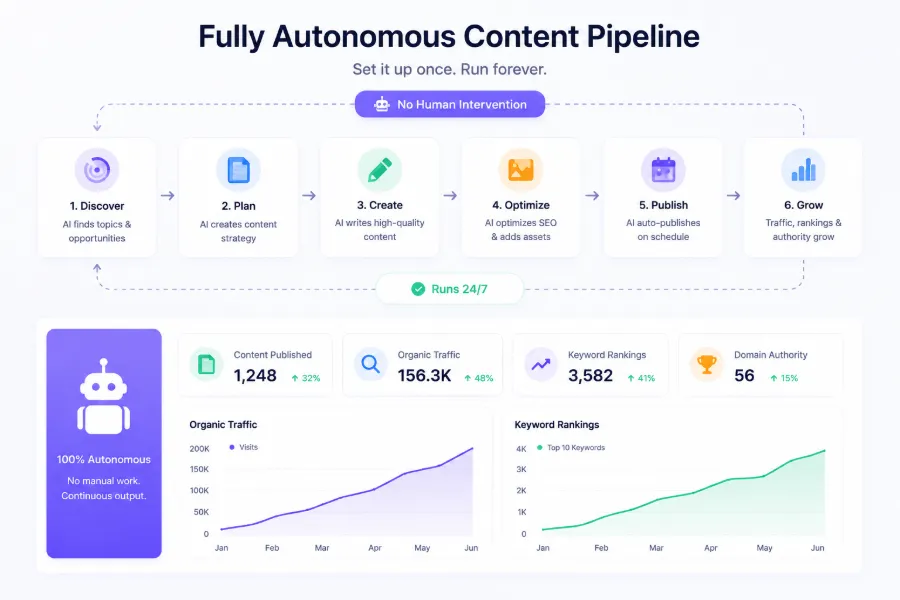
In practice, many site owners know they need high‑quality content but can’t keep up with publishing frequency. When updates stop, crawlers visit less often. To resolve this tension, I began automating the content production workflow. A useful approach is to use tools like SEONIB, which automate everything from trend discovery to multi‑platform publishing, turning content into a production line that continuously builds topical authority. For specific auto‑publish settings, see the AI Agent Auto‑Publish Guide. Another key aspect of content quality is structured data. Adding appropriate Schema markup to product pages and FAQ pages helps search engines understand page entities more accurately and increases exposure in knowledge graphs.
Technical SEO and user experience: how search engines score your site
Technical SEO in 2026 is a prerequisite, not a bonus. Google Core Web Vitals, Baidu Mobile Friendliness, and 360 Search Site Quality Score directly affect rankings. Google research shows that page load times over 3 seconds increase bounce rates by 32 %. If your site loads slowly, has poor mobile adaptation, or is cluttered with pop‑ups, even the best content will be harshly penalized. The reason is simple: search engines are recommendation systems; directing users to a laggy site harms the search engine’s own reputation.
Cross‑platform synchronization and content distribution efficiency are also part of technical SEO. Many sellers operate Shopify, WordPress, and independent sites simultaneously; manual uploads are time‑consuming and prone to missing update windows.
The video above demonstrates how to sync blog content to Shopify with one click. In practice, I often encounter indexing chaos caused by inconsistent content across platforms. Switching to automated synchronization saved time and kept SEO signals consistent. Multi‑store operators can refer to the Product‑to‑Blog Conversion Guide for bulk converting product pages into blog posts. Moreover, the search landscape in 2026 is no longer limited to traditional search engines. TikTok, Amazon, and ChatGPT have become traffic sources, and a strategy relying solely on Google can quickly become obsolete. To learn more about cross‑platform search optimization, read the article Stop Focusing Only on Google—SEO in 2026 Must Be Everywhere.
New rules for link building: from quantity games to genuine relationship networks
The 2025 traffic crash case was most severely damaged by spammy backlinks. The team bought over 200 forum signatures and auto‑comment links in a single week, creating an abnormal spike in the backlink graph. Search engine pattern‑recognition algorithms quickly flagged this as manipulation and triggered a ranking penalty. Such abnormal backlink growth (hundreds of links added within days) is identified and punished 90 % of the time, with almost no exceptions.
What is the correct direction for link building? Focus on authentic industry communities, publishing valuable guest posts and engaging in deep discussions to earn natural inbound links. Simultaneously, your brand’s reputation will feed back into link quality—when users actively search for your brand, third‑party sites are more willing to voluntarily cite your content. This “brand search” link equity far outweighs purchased links. Continuously outputting automated content gradually builds trust, attracting more natural citations. If you run a Shopify store, see the Connect Shopify Site instructions to automatically publish content to your store and draw industry citations through an updated blog.
For a more systematic technical integration checklist, consult the SEONIB Help Documentation—it provides a complete configuration guide from site building to multi‑platform sync.
FAQ
Q1: Is there still a future for SEO in 2026?
Yes. As long as users type experience‑based questions into search engines, SEO remains effective. The method has changed: from content piling and buying links to refined operations and high‑quality output. SEO in 2026 is more of a systematic engineering effort, requiring a blend of content, technology, and brand.
Q2: Will AI search make websites lose all traffic?
No, but it will reshape traffic structure. AI excerpts will capture some zero‑click queries, yet for queries that need deep comparison, purchase decisions, or subjective experience, users will still click through. Moreover, AI needs high‑quality content sources; the more authoritative your content, the more often AI will cite it, potentially bringing new exposure.
Q3: What should small and medium sites prioritize in 2026?
Priority order: 1) Content quality—ensure the first 10 % of articles hit the pain point and add structured data. 2) Technical foundation—optimize mobile friendliness and loading speed to meet Core Web Vitals. 3) Brand building—accumulate natural backlinks through industry communities and guest posts.
Q4: Are long‑tail keywords still important in the AI era?
Yes. AI handles generic knowledge queries well, but it still struggles with highly customized, industry‑specific, multi‑condition long‑tail queries. These account for over 70 % of total search traffic and represent the core opportunity for small and medium sites.
Q5: Can pure technical SEO alone achieve rankings?
No. Technical SEO is merely an entry ticket—ensuring crawlers can fetch and render pages. Ultimately, rankings depend on content quality and external trust signals (brand and natural links). In 2026, any weak dimension will drag down overall performance.
Share Article