Mini Teams, Massive Content: The Scalable Path for Future Unicorns
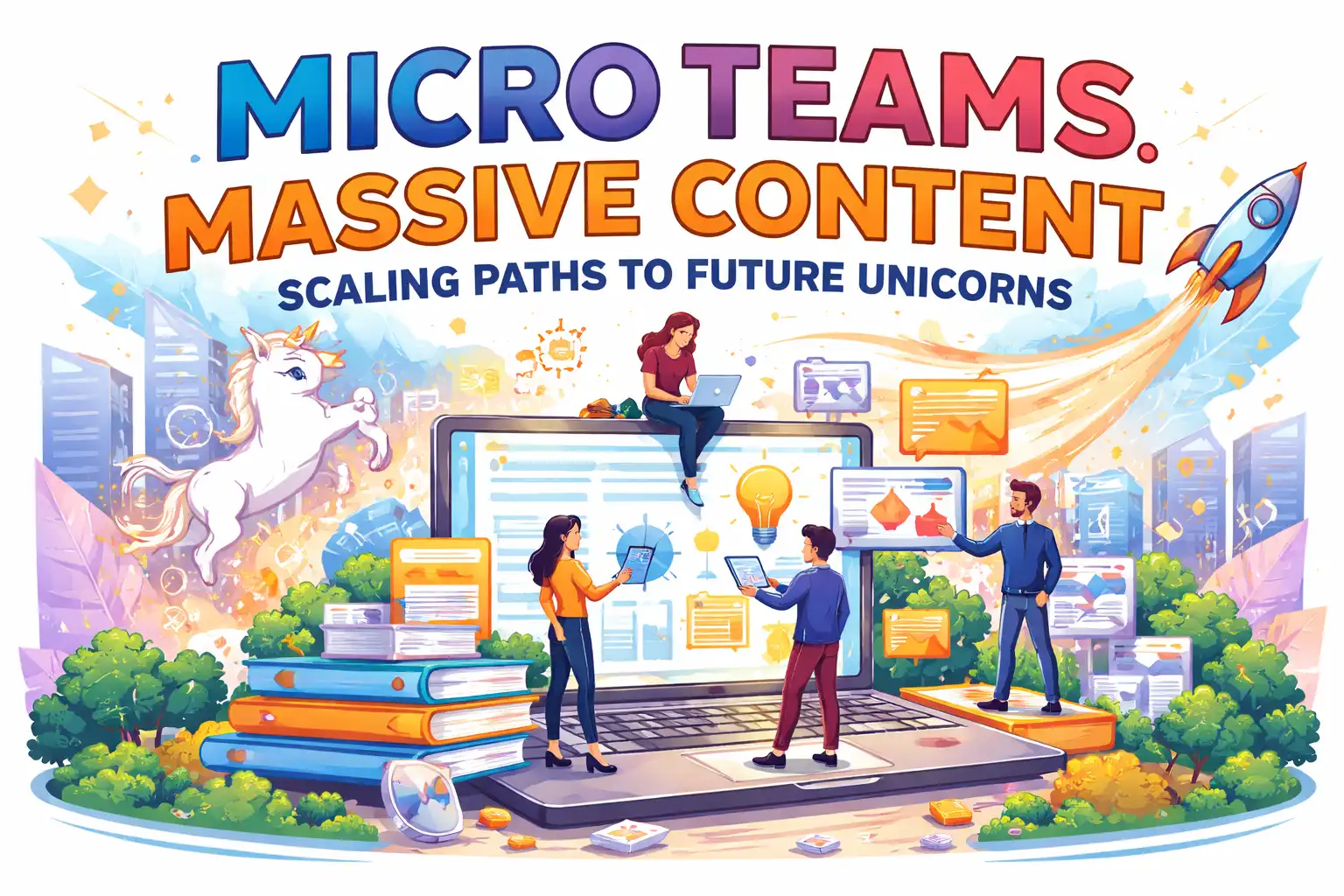
Over the past three years, several cross‑border brand teams I’ve been following have undergone a counter‑intuitive change: content marketing teams shrank from seven or eight people to one or two, yet organic traffic began to accelerate. This isn’t an isolated case; it’s a route validated simultaneously by a batch of independent‑site companies. With teams of fewer than five people, they rely on automated content engines to continuously produce high‑quality articles, building barriers in search engines and AI search platforms that competitors can’t catch up with in the short term.
The core of this model is turning content production from a “hand workshop” into an “automated assembly line”—topic selection, writing, editing, publishing, and maintenance are all handled by the system, leaving humans to make strategic judgments and handle exceptions. Below we break down the underlying logic of this engine and the launch method that any small team can copy directly.
Why Small Teams Can Win – The Leverage Effect of Content Engines
The human bottleneck in traditional content teams is very concrete: a topic goes through at least six stages—from research to publishing: topic meeting, writing, editing, layout, SEO optimization, and multi‑platform publishing. Three people doing this can only produce two articles per week at best. A content engine compresses these six steps into one button—trend discovery, generation, scheduling, publishing, and multi‑platform sync—all performed sequentially by the system.
The logic of the content flywheel isn’t complex. Every new piece of content adds an indexed page to search engines, incrementally increasing the site’s overall topical authority, which continuously lowers the cost of gaining search exposure for subsequent content. A typical cross‑border brand I tracked kept its content team at two people, but after moving from two articles per week to five per day, organic traffic grew 300 % in six months. The starting team size was the same; the difference was turning writing into a systematic pipeline.
There’s an often‑overlooked fact: small teams win not because AI replaces humans, but because the decision chain is short, allowing rapid testing of content strategies—e.g., if a keyword direction underperforms, the schedule and topic can be adjusted the next day. Large teams lose this agility due to lengthy approval processes.
From Trend Discovery to Automatic Publishing – The Four‑Step Workflow of a Content Engine
When you break down a content engine, it consists of four interlinked steps.
Step 1 – Trend Discovery. AI monitors industry dynamics and competitor content gaps in real time, automatically identifying topics with search demand and traffic potential, and pushes them directly into the topic pool. No more manual forum browsing or dashboard watching; the system tells you what to write today.
Step 2 – Content Generation. From keywords, product links, social posts, reference links, and other sources, it automatically generates structurally complete, SEO‑optimized articles. It supports more than 40 languages, meaning a cross‑border e‑commerce team can simultaneously cover English, Japanese, German, French markets without assigning a dedicated writer for each language. Tools like SEONIB already do this maturely, generating buyer guides and tutorial blogs directly from product links, linking product selection and content production.
Step 3 – Scheduling & Publishing. After setting the publishing frequency, AI automatically executes according to the calendar—whether three articles per week or five per day, depending on strategy rather than human capacity. The system populates the content calendar, making it clear what is scheduled for each day and whether it’s already generated.
Step 4 – Multi‑Platform Sync. One piece of content is automatically pushed to mainstream platforms such as Shopify, WordPress, SHOPLINE, etc. No need to log into each backend or copy‑paste manually. Multilingual versions are also automatically distributed to the corresponding sites or subdirectories.
The real value of this workflow isn’t “writing fast,” but “writing continuously.” Many underestimate the weight of stability in content marketing—search engines show a clear ranking preference for regularly updated sites. The difficulty of manually maintaining a publishing cadence far exceeds most teams’ expectations. Understanding this helps grasp how AI search indexes content; see the analysis in “How to Make ChatGPT Treat Your Site Like a Treasure” for more insight.
How Mini Teams Build a Content Flywheel
The content flywheel has three core stages: continuous output → index accumulation → search authority → more traffic → more content material. Starting this loop doesn’t require a large team, but it does need a stable content calendar for the system to fill automatically. For a deep dive on how brands build long‑term authority through content accumulation, see the “Compound Framework for How Content Builds Brand Authority” article.
The compounding effect of the flywheel is hard to feel in the first three months. In the cases I tracked, traffic was flat for the first three months and only began exponential growth by month six. Old articles keep gaining search exposure without manual upkeep—this is the biggest advantage of an automated content engine over traditional content operations. Consistency also directly impacts AI search rankings; related content can reference “Brand Consistency Is the Hidden Ticket to AI Search” for details.
However, there’s a critical failure point to watch out for. One team began purely AI‑generated content in early 2024 without configuring brand context or internal linking rules. They published five articles per day in month 1—high volume but lacking entity connections and thematic depth. In month 2 rankings rose briefly, then traffic plummeted 80 % in month 3. By month 6 the site was fully de‑ranked by search engines, traffic dropped to zero. Post‑mortem showed that search engine algorithms can now detect “pure machine‑stacked content lacking thematic continuity” and label it low‑quality aggregate pages.
The solution to this pitfall is quality control. Brand context—including industry terminology, product information, internal linking strategy, and asset library—must be pre‑configured so AI knows which brand each article belongs to and which existing pages to link. Otherwise, articles fight each other, and search engines can’t establish your topical authority. Detailed automated configuration steps are available in the official Help Documentation.
Special Value of Content Engines for Independent Sites and Cross‑Border E‑Commerce
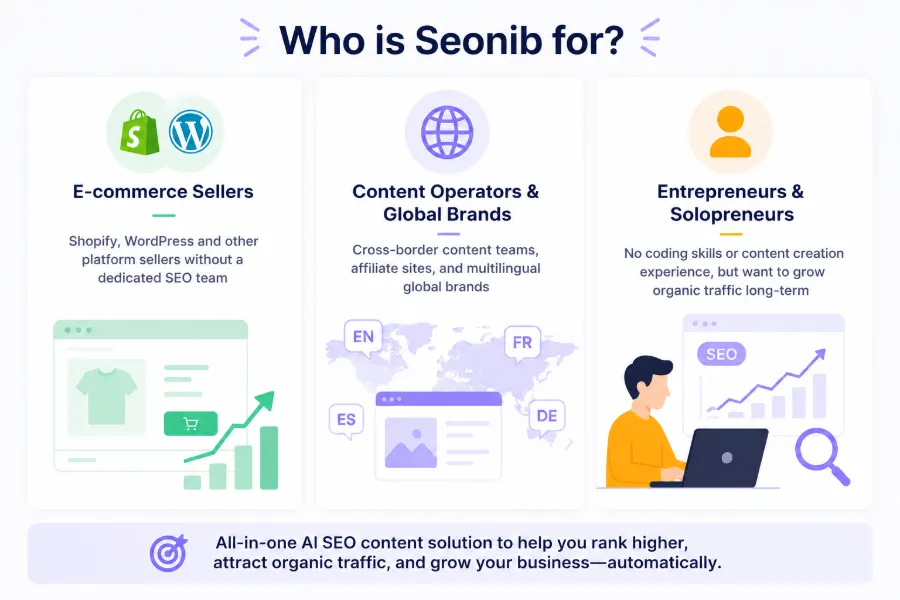
Independent sites and cross‑border e‑commerce are the two scenarios that benefit most from content engines. Independent sites lack built‑in platform traffic, making content almost the only long‑term free acquisition channel. The multilingual demand of cross‑border e‑commerce is another pain point—traditional models require at least one writer per language market, whereas an automated system can generate and distribute multilingual content in one go, handling translation and localization at once.

SEO and AEO dual battlefields are another emerging trend. Beyond traditional search engines, AI search tools like ChatGPT and Perplexity are becoming new traffic entry points. Structured, entity‑rich content has a higher display priority in AI search than ordinary short texts. SEONIB has specialized in AEO page generation for this purpose, helping content be indexed by both search ecosystems.
A Shopify merchant who enabled the content engine saw the average time for product keyword rankings to enter the top 10 shrink from six months to three months. The reason is that the engine continuously produces long‑tail keyword articles around products, gradually establishing topical authority for that category—search engines see the site covering almost every related topic in the niche and rank its pages higher. Shopify merchants can directly view the customized “Shopify Content Automation Integration Solution” for details.
Product cards can be automatically embedded into content; readers see relevant products while reading a blog and can click to the checkout page. This “content → product conversion” path is more natural and lower‑cost than traditional search ads or social media referrals.
FAQ
Q1: How much time does it take a small team to set up a content engine initially?
The setup phase takes about 2–3 days, mainly configuring the brand knowledge base (brand description, industry terminology, internal linking rules) and establishing the content calendar. After that, daily maintenance takes no more than 30 minutes for reviewing topic suggestions and checking publishing quality.
Q2: Will automatic content generation lead to repetitive articles that get penalized by search engines?
The key is configuring brand context and internal linking rules. Without these constraints, pure AI‑generated content can indeed become repetitive and shallow. Once brand assets and asset libraries are set, each article focuses on a different facet of the same brand, creating interlinked, complementary content that search engines reward with higher topical authority scores.
Q3: What built‑in advantages does the content engine offer for platforms like Shopify?
Shopify’s content engine can automatically link to the product database, inserting purchasable product cards into articles. It also supports one‑click publishing to multiple Shopify sub‑sites, with multilingual content automatically matched to the appropriate product catalogs. This saves a substantial amount of backend operational time for merchants managing multi‑site, multi‑language stores.
Share Article