
2026 Practical Guide to Selecting GEO Tools
Last year I was still stuck at my SEO desk, staring blankly at the ranking curve in Google Search Console—rankings were as steady as a rock, but traffic was plummeting. I remember it clearly: it was a Thursday afternoon in March 2026, and I had gone over the traffic reports for the past three months three times to confirm that the tracking code wasn’t the problem. Then I saw an industry report: by the end of 2026, China’s AI search engine monthly active users had reached 680 million, while the average usage time for traditional search apps fell 7.6% year‑over‑year. Those numbers were a splash of cold water on my face—users hadn’t disappeared; they just stopped using “search a query” to get information. They now throw their questions at AI platforms like Doubao, DeepSeek, and Kimi, waiting for an answer.
This article isn’t about “whether you should do GEO,” but about dissecting the differences between GEO tools and traditional SEO tools—from optimization targets and evaluation metrics to implementation methods—and providing a practical 2026 selection framework. I’ve been through the pitfalls; I don’t want you to repeat them.
Where Users Have Gone, the Optimization Target Has Changed
At the beginning of 2026 I ran a small test: I invested ¥20 k in paid content on my own standalone site, spent three weeks on keyword research, and met all technical page‑optimization standards, with Core Web Vitals all green. Then I asked an AI assistant, “Which platform is reliable for [brand’s category]?” In its answer, my brand appeared only at the very end of a comparative list—in the “you could also look at” tier.
That moment made me realize that the SEO logic of “getting the page onto the first page” is almost dead in the face of AI search. When AI generates an answer, it doesn’t prioritize your page just because it has high authority. It looks at the clarity of the content’s structure, the institutionalization of the source, and the precision of semantic matching. You could be on the first page of Google, yet not be mentioned at all in Doubao’s answer.
In 2026, China’s AI large‑model user base surpassed 880 million, with Doubao at 227 million MAU, DeepSeek at 136 million MAU. Traditional search‑app usage time fell 7.6% year‑over‑year. This isn’t a future trend; it’s already happening. If your optimization target is still “web page ranking,” you’re investing in a shrinking channel.
Three Fundamental Differences Between GEO and SEO – A Table Clarifies
Traditional SEO practitioners often feel confused when they first encounter GEO: the metrics, the objects, and the time to results are all different. The table below lays out the core differences clearly:
| Dimension | SEO Tools | GEO Tools |
|---|---|---|
| Optimization Target | Page ranking in SERPs | Frequency and context of brand mentions in AI answers |
| Evaluation Metrics | Keyword rankings, search traffic, CTR | AI mention rate, recommendation rate, sentiment, source attribution |
| Implementation Path | Page technical optimization + backlink building | Semantic structure reconstruction + knowledge‑asset structuring |
| Time to Visible Effect | 3–6 months | 4–8 weeks (first 2 weeks structuring, weeks 3‑4 first citations, weeks 5‑8 stabilization) |
I find the last timing difference quite ironic—SEO folks are used to “waiting three months for nothing,” while GEO’s feedback loop is so short it feels unbelievable at first. But there’s a trap: GEO’s speed hinges on having the right content structure. Simply taking an old article, having an AI rewrite it, and publishing it yields zero effect.
According to the assessment standards released by China’s Academy of Information and Communications Technology, a qualified GEO tool must have three core capabilities: AI‑simulated questioning, answer semantic parsing, and source‑attribution tracking. Paid GEO tools provide on average 3.8 × more data dimensions than free tools. SEO looks at rankings; GEO looks at “whether AI will actually mention you”—the logic may be messy, but the principle is sound.
From Keyword Stuffing to Semantic Reconstruction – Not a Content Revolution, but a Coming‑of‑Age
Traditional SEO follows a linear path: keyword research → on‑page optimization → backlink building → content updates → performance monitoring. The objects are HTML structure, meta tags, internal linking. I’ve been doing this for five years; I could run it blindfolded.
GEO’s path is completely different: structuring enterprise knowledge assets → multimodal content production → AI source building → AI dialogue coverage monitoring → iterative optimization. The objects are not page tags but the semantic logic of the content, the authority of the source, and the degree of structuring.
My real‑world experience after trialing three GEO tools at the start of 2026: most paid tools gave me data I still couldn’t understand. They told me “you weren’t mentioned by AI,” but not “why AI didn’t mention you.” The most outrageous case was a tool that claimed to support ten AI models but actually covered only three major Chinese platforms— the other models were just decorative names in the feature list.
Efficiency gaps are huge. Manual GEO analysis takes 3–5 working days per optimization cycle—human analysis of AI dialogue results, manual content‑structure adjustments, then regeneration. AI‑driven GEO tools, using batch keyword distillation, automatic content generation, and cross‑platform distribution, can compress a cycle to under 30 minutes.
For example, SEONIB automates this pipeline: you input a product link or keyword, AI automatically performs semantic analysis and content generation, then you publish with one click to multiple platforms. Before using it, I spent a week just organizing the brand knowledge base; each subsequent content update required manual repetition, constantly checking for structural collapse.
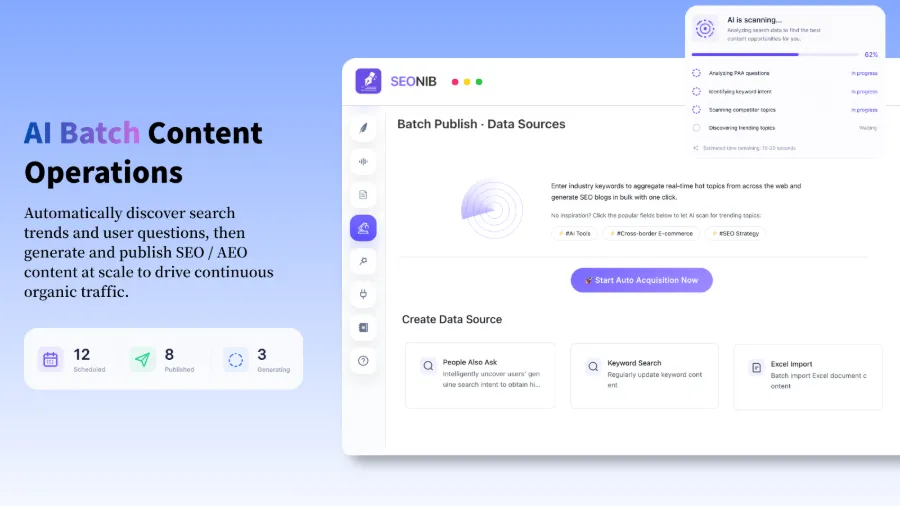
One less obvious observation: GEO’s success hinges not on the tool but on your pile of “human‑readable” product documents. Turning unstructured information into an AI‑understandable structured knowledge base is ten times more useful than keyword tweaking. I first standardized all the scattered Word docs, Excel sheets, and PPTs in my company into a unified knowledge asset, then ran GEO—results were completely different.
If you’re still unsure about how to support AEO with content, start with that framework. From my experience, AI cites content that “looks like it was written by a reputable institution,” not “SEO‑heavy” content. GEO optimization essentially helps you “de‑SEO” your content—sounds ironic, but it’s reality.
Another interesting observation appears in the article Why I Use Accio for Product Selection to Attract Customers: structuring knowledge assets is essentially feeding AI the “food” it can actually digest, not a pile of marketing jargon only humans can read. That piece details how to earn AI’s trust through structured content—an approach that aligns perfectly with GEO.
Regarding AI source building, the practical guide How-to-Make-ChatGPT-Treat-Your-Site-Like-a-Treasure sums it up in one sentence: the more orderly you present information to AI, the higher the chance it will cite you.
Selecting GEO Tools Can’t Be Based on Feeling – Five Quantifiable Dimensions to Guide Your Decision
When I first selected GEO tools, I made a rookie mistake: I was attracted by the number of models listed in the feature table, only to discover that most of them weren’t actually usable. I later distilled five measurable evaluation dimensions; using this framework each time prevents most pitfalls.
Dimension 1: AI Model Coverage. The domestic market should at least cover the five major models: Doubao, DeepSeek, Kimi, Wenxin Yiyan, and Tongyi Qianwen. Don’t be fooled by “supports 10 big models” slogans—ask exactly which platforms are monitored, whether there’s deep integration with Chinese models, and if the API truly connects to those platforms.
Dimension 2: Content Production Capability. Can the tool generate customized content based on your enterprise profile? Can it produce content at scale? How SEO‑friendly are the generated articles? A common pitfall: some tools’ “batch generation” merely swaps a few keywords in a template, resulting in terrible quality.
Dimension 3: Data Quantification Ability. This is the dividing line between paid and free tools. Free tools only tell you “mentioned” or “not mentioned.” Paid tools tell you who mentioned you, in what context, sentiment (positive or neutral), and why competitors get more citations. Without quantification, GEO can’t support iterative optimization. I usually refer to a SEONIB feature breakdown to see if source attribution and trend alerts are covered.
Dimension 4: Multi‑Platform Distribution Efficiency. How broad is the distribution coverage? Does it require manual format adaptation? How many platforms can it sync to? Domestic GEO tools have a natural advantage: they already adapt to WeChat Public Accounts, Zhihu, Baijiahao, etc., whereas overseas tools lack this capability.
Dimension 5: Cost‑Structure Transparency. Per‑use billing, subscription, or performance‑based? Are hidden costs disclosed? I tried a tool that was cheap at the base level, but once API call fees and model usage fees kicked in, the price tripled.
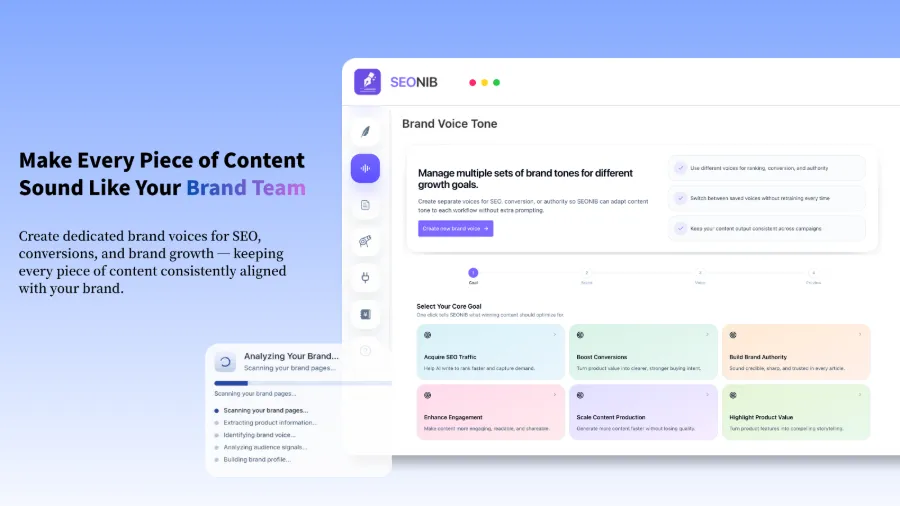
The “brand voice” configuration screen shows one facet of content customization. If a GEO tool can’t even set your brand’s basic tone, the generated content will likely clash with your brand identity—AI citations may then backfire.
Selection logic differs between domestic and overseas markets. Overseas, the main players are Google AI Overview, ChatGPT, and Gemini, with SEMrush and Ahrefs already offering mature GEO modules. However, their keyword distillation accuracy in Chinese is inferior to domestic tools. My advice: if your target audience is domestic, prioritize tools that support Chinese AI models; if you need both, consider a hybrid approach.
First Step Isn’t Buying a Tool, It’s Turning Your Scattered Materials into AI‑Readable Form
My deepest insight after years of trial and error: don’t impulsively subscribe to a GEO tool. First, clean up the Word documents on your computer labeled “V3.2.1 final,” “V4.0_rev_no‑rev,” etc.
The implementation framework can be broken into four steps:
1. Build an Enterprise Information Repository. Company overview, product descriptions, brand positioning, core advantages—all must be organized in a standardized, structured format. This step seemed trivial at first, but it turned out to be the highest‑ROI investment in the entire GEO optimization process. Once the repository is ready, GEO tools can generate content based on brand context rather than generic templates.
2. Organize Brand Trust Credentials. Certifications, client case studies, industry awards—these are the key materials AI uses to judge source reliability. Without them, even if AI cites you, it will place you in a “also an option” tier rather than a “recommended” tier.
3. Build an Industry Knowledge Base. Industry reports, technical whitepapers, product manuals. Categorize by theme, annotate each document’s core conclusions and key data. The goal is for AI to quickly locate and cite your content when answering industry‑related questions.
4. Cross‑Platform Distribution and Ongoing Iteration. After content generation, push it to mainstream media platforms and continuously track AI citation performance. The first two weeks are for structuring; weeks 3‑4 see the first citations; weeks 5‑8 stabilize. I used SEONIB for this because its keyword‑distillation feature helped me filter truly semantically valuable long‑tail terms from a sea of keywords, and its knowledge‑base management and cross‑platform publishing saved me a lot of time. I’m not endorsing it; it’s simply the tool that, after my own comparisons, saved me time. GEO’s effectiveness depends on the content itself; the tool just speeds up the process.
These steps can be followed using a complete help document. The initial organization may feel tedious, but you’ll soon realize that the degree of knowledge‑asset structuring directly determines the upper bound of AI citation performance.
If you want to learn more about overall SEO strategy and how GEO integrates, check out the AI SEO Guide (2026). For platform integration, the guide on Connecting Your SHOPLINE Site to SEONIB covers many specific issues faced by cross‑border sellers.
AI’s “answer citation” is essentially a trust game—it prefers content that “looks like it was written by a reputable institution,” not “SEO‑heavy” content. So GEO optimization is really helping you “de‑SEO” your content. It sounds ironic, but that’s the reality. You can perfect keyword density and hard‑wire internal and external links, but in front of AI, a well‑written, human‑like product description with clear logic and bullet points is far more valuable.
Frequently Asked Questions
Q1: Should a company use both SEO and GEO tools, or pick one?
Currently they are complementary, not substitutive. SEO drives traffic from traditional search engines; GEO covers brand exposure in AI search scenarios. If budget allows, use both to cover the full path from keyword search to AI query. If you must choose, look at where your traffic comes from—if 80 % of users still rely on traditional search, solidify SEO first; if users have already shifted heavily to AI search, prioritize GEO.
Q2: I’ve been doing GEO optimization for two weeks and see no activity—normal?
Absolutely normal. GEO’s effect timeline is 4–8 weeks: the first two weeks are for structuring assets, weeks 3‑4 bring the first AI citations. If nothing shows up after two weeks, check whether your foundational information repository is complete—I’ve seen people dump a mountain of product detail pages into a GEO tool without any contextual information, leaving AI clueless about how to cite them.
Q3: What’s the difference between cloud‑based GEO tools and on‑premise GEO tools?
Cloud GEO tools require no ops, get timely updates, support API integration and team collaboration, and are suitable for most SMBs under a subscription model. On‑premise tools offer data security, custom model training, and are ideal for heavily regulated sectors like finance or government, but they demand a large upfront investment in deployment and maintenance.
Share Article