Why Your Page Ranks on Google’s First Page but AI Doesn’t Cite It

My article stayed at the #2 spot on Google’s homepage for almost half a year, with normal daily clicks and reasonable conversions. Then one day I asked ChatGPT an industry question and discovered it cited a deep, long article from a competitor’s mid‑tier page—an article that never made it into Google’s top 20 and had barely any traditional SEO work.
This isn’t a coincidence. Search and ranking are completely separating.
Over the past year I compared several hundred prompts, checking the Google ranking positions of my own and competitors’ pages against their citation status in ChatGPT, Perplexity, and Gemini. The conclusion is clear: your Google rank and whether AI cites you are two completely different selection systems. This article starts with quantitative evidence of the citation gap, breaks down the four underlying mechanisms AI engines use to select sources, and then offers a weekly executable detection‑and‑repair loop.
Ranking vs. AI Citation: Two Completely Different Selection Systems
First, a set of data that made me rethink my whole content strategy. Ahrefs analyzed 15,000 prompts in September 2025 and found that only 12 % of URLs cited by ChatGPT, Gemini, or Copilot also rank in Google’s top 10. In other words, 88 % of AI citations come from pages that never entered the top 10.
A more extreme study by Semrush showed that when ChatGPT cites a page, the chance that the page ranks beyond #21 in traditional results is close to 90 %.
What does this mean? If you’re still optimizing content based on Google ranking standards, you may be pushing in the wrong direction.
There is an exception worth noting. Google AI Overviews still source about 38 % of citations from the top 10 natural search results, meaning ranking remains important on Google’s own surface. But independent AI assistants use a completely different selection logic; they don’t consult Google’s ranking algorithm but run their own retrieval and synthesis pipelines.
Click traffic is also shifting toward AI. Analysis of 33 million sessions shows AI‑recommended traffic accounts for about 1.08 % and is growing at roughly 1 % per month. For most sites this share is still small, but the trend is clear. To learn a traffic‑growth path that doesn’t rely on ads, see my previous guide “How to Grow Traffic Without Ads”.
The core conclusion: Google ranking has become just one of several input signals for AI selection and no longer determines whether AI will cite you.
Four Mechanisms AI Engines Use to Trust Content: Why Your Page Falls Out of the Citation Pool
AI engines don’t consult Google’s ranking algorithm; they run their own retrieval and synthesis pipelines. The signals rewarded by these pipelines are fundamentally different from traditional ranking.
Entity recognition takes precedence over keyword density. AI parses a page into a set of entities—people, objects, concepts, and their relationships—rather than isolated keywords. A page that repeatedly mentions a topic without clearly defining entities, attributes, and relationships is essentially invisible at the retrieval layer. Keyword stuffing does nothing for AI retrieval.
Timeliness carries far more weight than on Google. A large study covering 17 million AI citations found that AI‑cited URLs are on average 25.7 % newer than Google’s contemporaneous natural search results. A page published 18 months ago can retain its Google rank for years, yet it quietly disappears from AI answers as newer content arrives. This is structural citation decay, not a quality issue.
Structural clarity determines extractability. Engines extract claims, not paragraphs. Hiding insights in long, unbroken blocks of text loses to pages that present the same information via question‑style H2 headings, 200‑400‑word semantic blocks, or numbered lists.
The citationability of the statement itself. The density of independent declarative content determines whether a piece of information can be extracted as a complete answer.
| Signal Dimension | Google Ranking Preference | AI Citation Preference |
|---|---|---|
| Evaluation Unit | Page‑level relevance | Claim‑level citability |
| Timeliness Weight | Moderate, periodic crawling | Heavy, rotates within weeks |
| Structural Preference | Comprehensive coverage | Question titles, semantic blocks |
| Authority Signals | Backlinks, domain authority | Entity recognition, source credibility |
| Main Failure Mode | Rank drop of a few positions | Falling out of the citation pool |
A Four‑Step Weekly Loop to Audit Your Content Library
Understanding the mechanisms turns the problem into a systematic audit. I run a four‑step loop each week, which I’ve been doing for over three months.
Step 1: Audit. Export the pages indexed in the last 90 days and daily AI citation sources, then identify URLs that rank but receive zero citations. The rule is simple: pages in Google’s top 20 that have not been cited by any major AI assistant for 30 consecutive days go onto the action list.
Step 2: Diagnose. Examine each URL’s entity coverage, freshness, and semantic‑block structure. I usually break the page down at this stage: are the entities clear, is the last update older than 18 months, is the content organized into semantic blocks? After pinpointing missing elements, I tag each page accordingly.
Step 3: Repair. For high‑value old articles, add missing entities, split into semantic blocks, and update the publication date to the present. This isn’t just changing a date; it’s truly filling in the missing entity relationships.
Step 4: Publish. Push the revised drafts back to the target platform and enter the next weekly monitoring cycle.
This loop can be embedded in a CMS and automated publishing workflow. If you use SHOPLINE, I wrote a more detailed guide “SHOPLINE Stores Winning AI Citations” that breaks down the execution details per platform.
The key is periodic execution, not constant rewriting. A 90‑day rolling monitoring window is a reasonable cadence—too short and you miss trends, too long and you miss early decay signals. Methodologically, Google’s official guidance on AI search visibility can serve as a calibration benchmark.
Repair Is Just the Starting Point: Align Existing Content with AI Citation Candidate Structure
Fixing a single old article is only the beginning. The real issue is whether your entire existing content library aligns with the structure AI looks for in citation candidates.
Content updates shouldn’t stop at changing dates or rewriting introductions. The focus should be on increasing “statement density”—organizing facts, data, and comparisons into independently citable semantic units. A page with 20 extractable statements is far more likely to be cited than a longer page with only 3 statements.
In existing brand and product pages, prioritize strengthening the entity‑recognition layer. Clearly defining entity attributes and relationships is far more effective than stuffing more keywords.
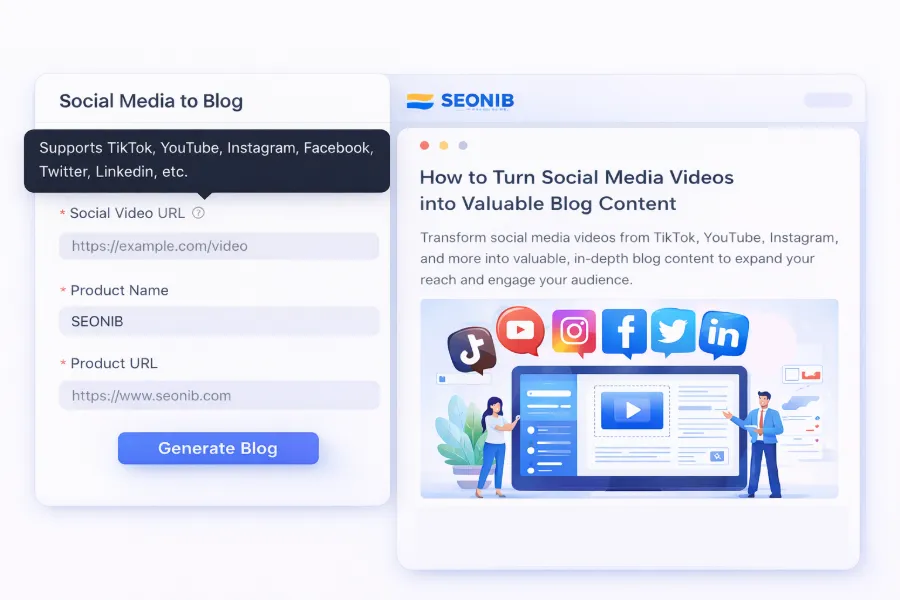
Cross‑platform content duplication is another often‑overlooked point. If the same topic is published on Shopify, WordPress, SHOPLINE, etc., and the versions differ, AI retrieval encounters contradictory signals. Automating synchronization across platforms ensures consistent citation candidates. Repurposing social media content into blog posts is also a low‑cost way to supplement citation candidates:
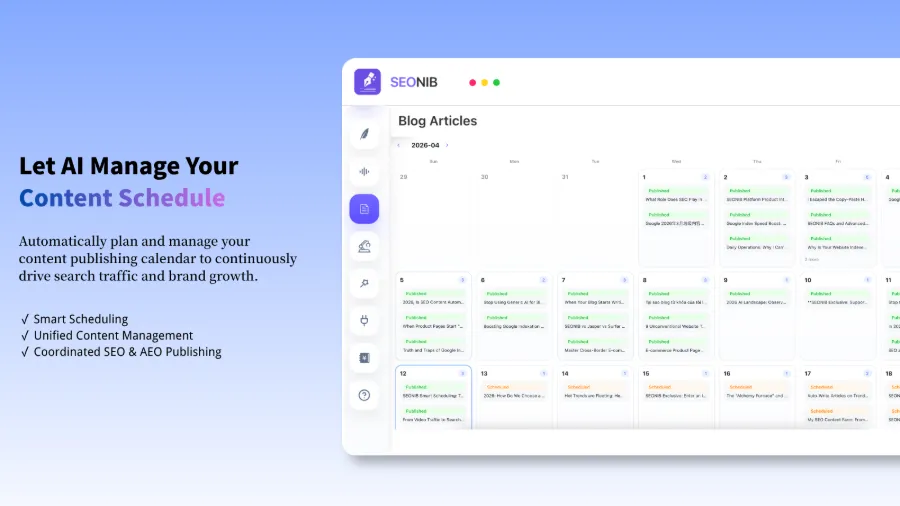
Combine this with a content calendar for frequency planning, and use 24⁄7 automation to keep the freshness signal alive. I use SEONIB for automatic scheduling and cross‑platform syncing—it can generate and publish content on a set frequency, supports 40 languages, and eliminates the weekly manual login and upload grind. A detailed feature breakdown is available in a comprehensive guide.
The ultimate goal is to solidify the loop into a scheduled task, reducing manual weekly work. With webhook‑triggered scheduling, the whole process can run unattended. When deploying an automated pipeline, first consult the SEONIB help docs for full configuration, then set frequencies based on your content volume.
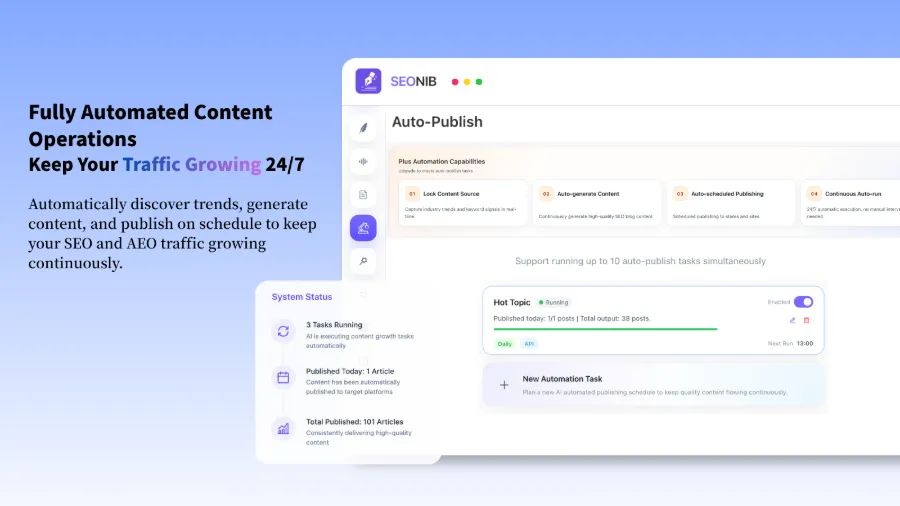
My current workflow: spend 20 minutes every Monday morning reviewing the audit list, and let automation handle the rest. After three months, the number of AI‑cited pages more than doubled, while Google rankings barely changed—exactly confirming the opening statement: two systems, each running its own course.
FAQ
Q1: My page is in Google’s top 10, why does AI never cite it?
Because AI engines don’t consult Google’s ranking algorithm. Ahrefs shows that only 12 % of AI‑cited URLs also rank in Google’s top 10. Your page may fail AI’s selection criteria for entity coverage, timeliness, or structural clarity; rank alone isn’t sufficient for AI citation.
Q2: How does AI citation decay happen? Can old articles regain citations?
AI‑cited URLs are on average 25.7 % newer than Google natural results; pages older than 18 months naturally decay. Recovery involves adding entities, splitting into semantic blocks, and updating the publication date—not just changing the date. I’ve seen a 22‑month‑old article reappear in ChatGPT citations within about six weeks after those three fixes.
Q3: What types of pages are most likely to be cited by AI?
Pages with clear structure, explicit entities, and high statement density. Specifically, pages that use question‑style H2 headings, 200‑400‑word semantic blocks, and contain independently extractable facts or data comparisons have a noticeably higher citation probability.
Q4: How long does it take for a repaired old article to show results?
It depends on the decay level. Light repairs (adding entities, splitting semantic blocks) usually show changes within 2‑4 weeks; if the content needs extensive rewriting or new data, it may take 6‑8 weeks. AI’s re‑crawling and indexing cycle is longer than Google’s, so patience is required.
Q5: Do I need to check citation rates weekly? How often should I audit?
A 90‑day rolling window with weekly audits is recommended. Spending a small amount of time each week exporting citation sources and flagging anomalies is easier than a monthly deep dive and helps catch early decay signals. Too low a frequency misses trends; too high a frequency may flag normal fluctuations as problems.
Share Article