The Best AI Tool Stack for Content Creators: Building a Truly Automated Workflow
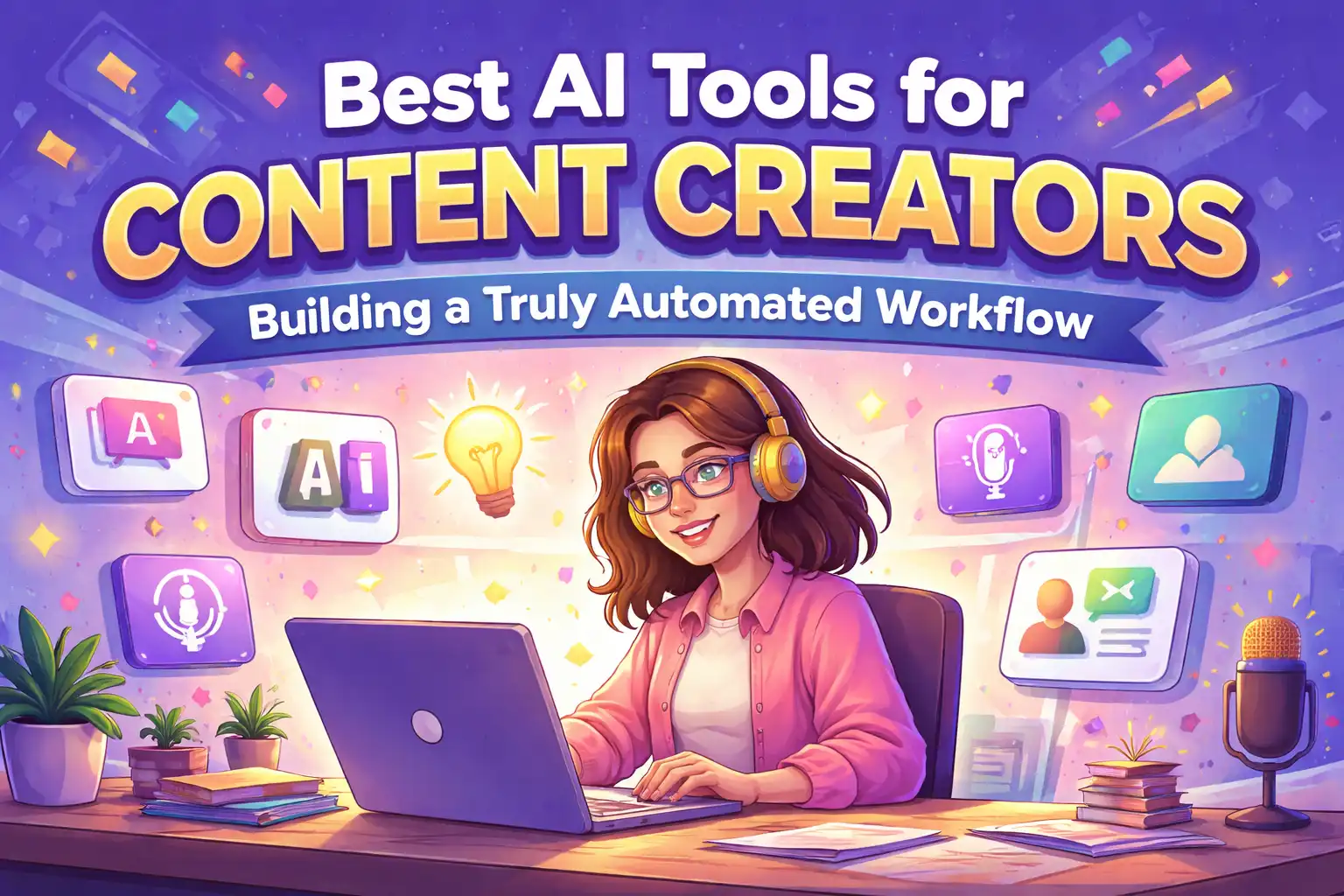
Anyone who has used AI writing tools has probably experienced this awkwardness: the tool generates a draft for you, but you still have to proofread, add images, fill in SEO tags, and manually copy it into each backend for publishing. After going through the whole process, the time saved is completely lost, sometimes even more troublesome than writing from scratch. This “semi‑automation” not only fails to improve efficiency but creates new bottlenecks. This article does not intend to list another set of tools; instead, it focuses on how to truly stitch together the four stages of AI‑driven trend discovery, content generation, SEO optimization, and multi‑platform publishing into a content production line that can run continuously without human supervision.
From “Idea Drought” to “Automatic Push” — How AI Takes Over Trend Discovery
The biggest pain point for content creators isn’t that they can’t write, but that they don’t know what to write about. I used to spend 5–7 hours a week manually scrolling through social media and industry forums to find topics. Sometimes an hour of scrolling yielded no viable direction, and I still had to make up for it over the weekend.
AI’s real‑time monitoring advantage is obvious here. You set a seed list of keywords—e.g., “Shopify SEO,” “independent site traffic,” “cross‑border product selection”—and the tool continuously tracks Google Trends and competitors’ content updates, automatically generating a topic list with traffic‑potential assessments. It doesn’t randomly grab hot topics; it combines search volume, competition, and the performance of your past content to rank the topics that are worth writing about.
This mechanism compresses topic‑finding time to near zero. Open the tool each day, the topic pool is already updated, and you just glance at it to decide what to write first.
Content Generation — AI Outputs More Than Text, It Includes an SEO Framework
Older AI writing tools had a common problem: the output was a rough draft that you still needed to add H‑tags, write meta descriptions, and arrange internal links—quite a bit of engineering work. A colleague once told me he used ChatGPT to bulk‑write a month’s worth of articles, only to see natural traffic drop after two months. Investigation revealed that none of the articles had SEO structure, and internal links contradicted each other, forcing a two‑week rebuild—more exhausting than writing from scratch.
Modern solutions are different. Input a keyword or product link, and the generated content already includes a complete SEO framework—title hierarchy, meta description, internal‑link strategy, entity markup, etc. For example, feed a product link and the AI can automatically produce a long‑form review (1,200–2,000 words) plus an AEO Q&A section (3–5 question‑answer pairs), covering both traditional search engines and AI engines.
This capability isn’t inherent to generic large models; it requires dedicated optimization for content workflows. Tools like SEONIB are built specifically around the two scenarios “keyword‑driven SEO article generation” and “AEO Q&A page.” The colleague who hit the earlier pitfall later switched to such a combo, and his content output speed rose while his traffic curve began to recover.
Multilingual generation is also useful at this stage. For cross‑border e‑commerce teams, dropping a product link into the tool automatically produces both Chinese and English versions, eliminating a separate translation step and saving a communication loop.
Additionally, you can bind external authoritative sources during generation to boost credibility. For instance, when writing about Shopify store optimization, you can cite the Shopify official guide as a supporting source, improving both quality and trustworthiness. The detailed workflow is described in the Keyword Blog Writing Guide for configuring input sources.
Publishing and Syncing — Set a Rule Once, AI Executes on Schedule
Finishing content creation doesn’t mean the job is done. Many teams end up with drafts sitting in a folder for weeks before they remember to publish, resulting in an irregular posting rhythm. Search engines treat consistent updates as a trust signal; a “three days on, two days off” cadence struggles to earn stable traffic recommendations.
A content calendar with scheduled automatic publishing solves this problem. Set a publishing frequency—e.g., one article per day, three per week—and let the tool handle the rest. You no longer need to log in daily to trigger publishing; the system automatically generates and publishes on the schedule you defined, running uninterrupted for 365 days.
For cross‑border sellers with multiple site‑building platforms, the value of “single creation, multi‑platform sync” becomes even clearer. You might have a Shopify store, a SHOPLINE site, and a WordPress blog—previously requiring three separate logins and uploads. Now a single publish syncs to all platforms.
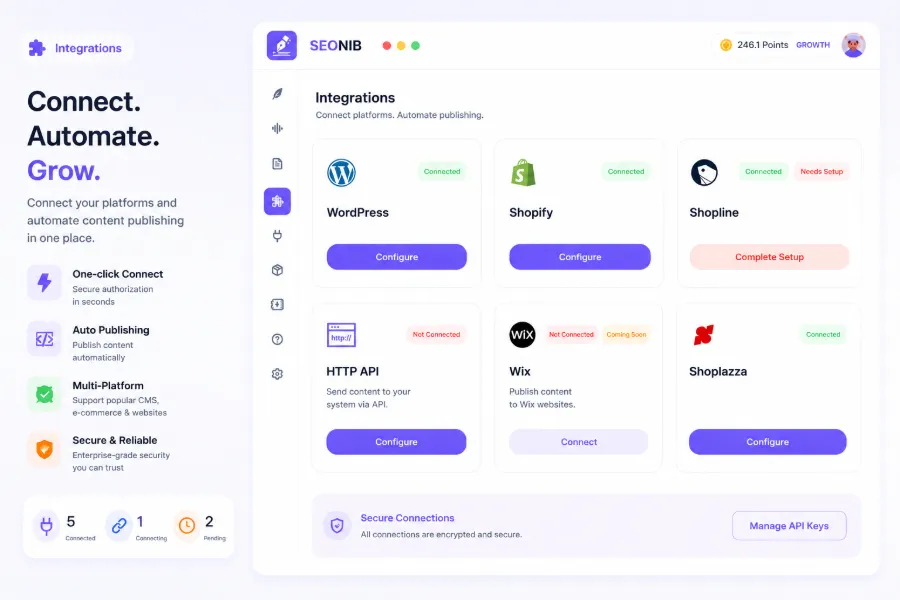
SEONIB even supports preview and adjustment before publishing, allowing you to catch style or brand mismatches early. For detailed scheduled‑publishing configuration, refer to this step‑by‑step guide. If your site is on SHOPLINE, see the instructions on how to connect a SHOPLINE site with SEONIB.
Multi‑Channel Distribution and Search Visibility — Full Coverage from Google to AI Search
Your content is ready and being published steadily; the next question is: where do users see it?
The old answer was Google. The landscape has changed. Users’ purchase‑decision paths are increasingly fragmented—ChatGPT queries, Reddit threads, TikTok reviews, then a Google search for verification. If your content only appears in Google results, it may be skipped before users even notice it.
A well‑performing blog post in traditional SEO, after proper AEO adjustments, can tap 3–5 additional AI‑driven traffic sources. This means the same content must rank in Google’s top 10, be cited in ChatGPT answers, and be mentioned in Gemini summaries. The core idea is to structure content so AI engines can also understand it. AEO (AI Engine Optimization) does exactly that—standardizing Q&A structures, entity tags, and structured data to make it easier for AI to recognize and directly quote your content.
You also need to consider how the content appears on social media. Once your article is synced across platforms, brand consistency becomes an often‑overlooked but hugely impactful factor. Both Google and AI engines recognize stable brand signals. An internal strategy note titled Brand Consistency Is the Hidden Ticket to AI Search Favor analyzes this in detail.
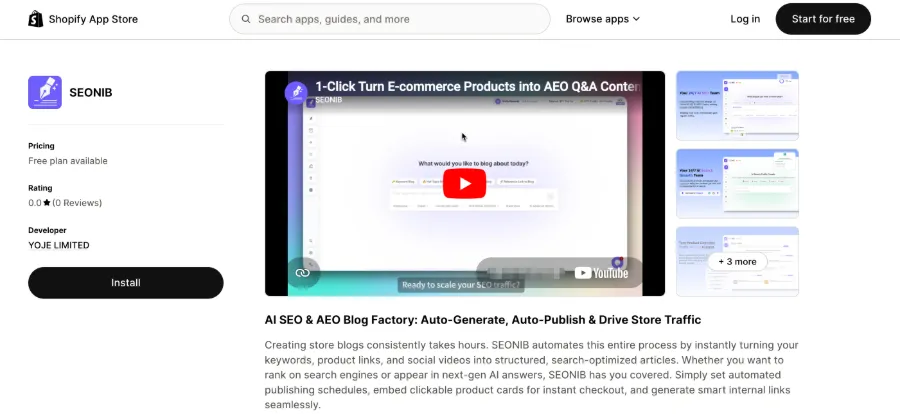
The 2026 search ecosystem is no longer dominated by Google alone. SEO strategies in 2026 must avoid a Google‑only focus and incorporate AI search and social‑media search into the distribution plan, ensuring your content budget isn’t wasted on a single channel. To learn more about how content can be adapted for AI‑engine citation mechanisms, see 7 Proven Ways to Get Your Content Cited by AI Answer Engines.
FAQ
Can the AI tool stack connect to my Shopify or WordPress site?
Yes. Most SEO‑focused AI content tools support direct integration with major site‑building platforms. Once connected, generated content is pushed straight to your site’s backend and scheduled for publishing without manual upload.
Will automatically generated content be flagged by Google as low quality?
If the content is just keyword stuffing and lacks structure, it can be deemed low quality regardless of whether it’s AI‑generated. The core value of automation tools is to help you output “structurally complete, well‑sourced, SEO‑compliant” content. As long as the content provides genuine information, Google won’t downgrade it simply because it originated from AI.
How much budget do I need to set up such an AI tool workflow?
Basic combos start at a few dozen dollars per month, covering topic discovery, content generation, scheduled publishing, and basic SEO optimization. As traffic grows, you may upgrade to plans that include AEO optimization, multilingual support, and multi‑platform syncing, typically ranging from $100 to $300 per month.
How does AI‑generated content ensure consistent brand voice?
The key is whether the tool supports configuring a “brand context.” You can pre‑define brand description, target audience, preferred terminology, and tone. Subsequent articles are generated based on that configuration, preventing the “each article sounds like a different author” problem.
What’s the difference between SEO and AEO in content generation?
SEO optimization targets traditional search engines like Google, focusing on keyword density, title matching, and internal‑link distribution. AEO targets AI engines such as ChatGPT and Gemini, emphasizing Q&A structure, clear entity markup, and comprehensive knowledge coverage. Both optimizations need to be applied in parallel because users may discover your content through either entry point.
Share Article