
The Biggest Productivity Upgrade Is Not AI, but Automation

Almost every cross‑border e‑commerce operator has gone through this loop: spend half an hour using AI to generate a blog post, then two hours formatting, adding images, filling in SEO metadata, translating into multiple languages, and finally logging into Shopify, WordPress, SHOPLINE back‑ends one by one to publish manually. Writing itself accounts for less than 20 % of content production time; the remaining 80 % is spent on repetitive, mechanical, non‑creative tasks. This isn’t an AI problem—it’s a problem of the “AI + manual” semi‑automated model. The real productivity bottleneck has never been generating content, but the long list of chores that nobody wants to do but must be done after generation.
If you want to quickly turn reference links into full blog posts, see this guide: Guide to Converting Reference Links to Blog Posts
AI Tools Are Not the Productivity Bottleneck; Manual Operations Are
Many teams that introduced ChatGPT found that the boost in work efficiency was far less than expected. The root cause isn’t that AI writes poorly; it’s that only the “writing” step is handled by AI while the rest—topic research, formatting, SEO metadata filling, internal linking, multi‑platform distribution—still has to be done manually, one by one.
Comparing the time consumption of the two models makes this clear:
| Stage | Manual Time | Automated Time |
|---|---|---|
| Topic & keyword research | 20–30 minutes | System automatically pushes suggestions |
| Content writing | 30–40 minutes (including human edits) | AI‑generated content goes straight into the workflow |
| SEO metadata configuration | 15 minutes | Auto‑filled |
| Formatting & image insertion | 20 minutes | Automatic |
| Multi‑platform distribution | 30–45 minutes | One‑click sync |
Data shows that manually publishing a 1,500‑word blog takes an average of 2.5 hours, and less than 30 % of that time requires genuine human judgment. The remaining 70 % is pure repetitive labor. In other words, if a team publishes three pieces of content per week, nearly five hours are spent on formatting and distribution—tasks that “AI can’t handle but humans have to do.” That’s the huge gap.
How Automation Reshapes the Content Production Workflow for Cross‑Border E‑Commerce
The core of content automation isn’t “using AI to write,” but a closed loop from topic selection to publishing. In the cross‑border e‑commerce scenario, this loop is especially valuable: operators no longer need to repeatedly log into different platform back‑ends, nor repeatedly fill in H1, meta description, alt text for each article, nor manually verify internal links.
The interesting part is the consistency automation brings. When a system takes over the entire pipeline from generation to publishing, brand style, internal linking strategy, keyword density, and other SEO‑critical factors become standardized. Building topical authority relies not on a single viral post but on a steady rhythm of content output and deep thematic coverage. Manual work can’t guarantee that every article follows the same internal linking rules and metadata format, but automation can.
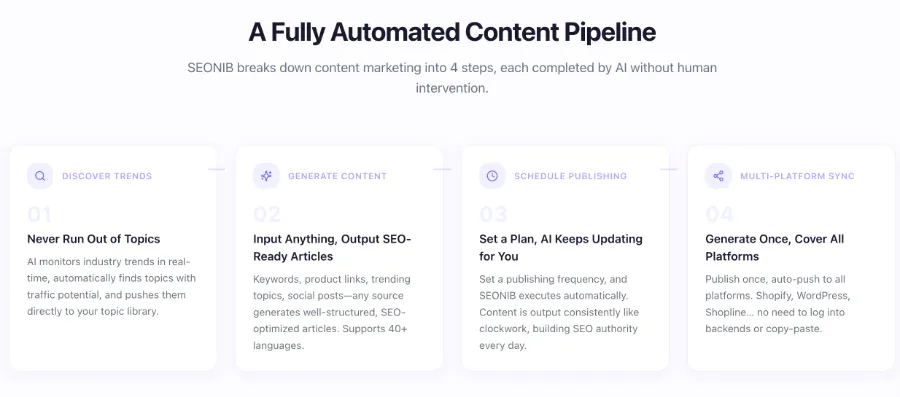
Some tools already achieve end‑to‑end automation. For example, SEONIB integrates trend discovery, content generation, SEO optimization, and multi‑platform sync into a single pipeline. Operators only need to review topics and calibrate direction; the rest is handled by the system.
For detailed usage instructions, see the help documentation: Help Documentation
Data shows that an automated workflow can compress the time to produce a single piece of content from 2.5 hours to about 15 minutes. This compression isn’t due to faster AI writing; it’s due to eliminating waiting and switching costs between steps. When content sources need to be diversified, refer to this guide: how to turn a reference link into a structurally complete blog post—essentially mapping an information source automatically into a standardized content format.
To further improve your store’s search performance, check out the best SEO tool: Best SEO Tool for SHOPLINE Stores
From Trend Discovery to Multi‑Platform Publishing: A Complete Automated Pipeline
Breaking this pipeline down reveals four key stages, each addressing a pain point unique to cross‑border e‑commerce.
The first stage is trend discovery. Most teams’ biggest pain isn’t the inability to write, but not knowing what to write about. An automation system can monitor industry hot topics, competitor content changes, and keyword search trends in real time, continuously pushing high‑potential topics into the topic pool. Tools like the [Accio product sourcing platform] provide similar trend insights on the supply‑chain side; on the content side, a comparable mechanism is needed to ensure topics aren’t chosen arbitrarily.
The second stage is content generation. Input a keyword, a product link, a social media post, or a reference link, and the system automatically generates a structurally complete, SEO‑optimized article. For cross‑border e‑commerce, covering 40 languages and maintaining multilingual content consistency is more important than how well the article is written.
The third stage is scheduled publishing. Systems like SEONIB’s scheduler can execute at predefined frequencies; operators only need to preview and confirm on a calendar. This rhythm is crucial for building search visibility—Google prefers sites that are continuously updated, yet most teams can’t maintain regular updates.
The fourth stage is multi‑channel sync. After content is produced, publishing isn’t finished by posting to a single site. Shopify, WordPress, SHOPLINE, and possibly Medium, LinkedIn, each need their own copy. For technical implementation of multi‑platform sync, see the HTTP API Push and Integration Guide, which explains how to distribute content to different back‑ends via a single interface.

Over 70 % of cross‑border e‑commerce teams spend more than six hours per week on content distribution, which translates to two full days per month spent on copy‑pasting. Automation eliminates those actions while preserving the flexibility to adapt formats for each channel. If you want to know exactly what it takes to set up such a system from scratch, consult the full automation configuration guide.
Avoiding Automation Pitfalls: When Is Human Intervention Needed?
Full‑scale automation sounds wonderful, but blindly copying it can lead to trouble. One team, running a niche independent site, started with strong confidence in automated production, setting a cadence of two posts per day for three months. The result: search traffic didn’t increase; it actually dropped by about 20 %. Analysis showed that the generated content was overly focused on a few high‑search‑volume keywords, causing a large amount of semantically similar content that search engines flagged as low quality, leading to keyword rank loss. It took three months to identify the issue, adjust strategy, and recover the original traffic levels.
This case illustrates a principle: automation’s value lies in execution, not decision‑making. Content strategy, brand tone calibration, and major event response still require human input. Two often‑overlooked observations: first, the real leap in automation isn’t “writing,” but “tuning.” Automatically adjusting future topic direction based on the ranking performance of earlier content is true automated optimization. Many systems only achieve “automatic writing” without “automatic strategy adjustment.” Second, most AI tools treat “human‑machine collaboration” as “human first, machine later”—the human decides what to write, then AI assists. Automation should be “machine first, human later”—the system publishes, and humans only need to periodically review and calibrate direction, not participate in every production step.
During the topic review stage, you can refer to methods for quickly validating product search demand to ensure every automatically pushed topic has commercial value. For a concrete automation example, a Chinese community article titled “One‑Click Turn Product Pages into Blogs with SEONIB” demonstrates how to quickly convert product pages into SEO content, a typical scenario combining human input and automated execution. Designing brand voice and entity SEO still ultimately requires humans to set rules, so the system doesn’t deviate during execution.
FAQ
Q1: Will content automation cause SEO penalties?
If configured properly, no. Penalties usually occur when content is highly duplicated or lacks editorial value. The automation tool itself isn’t the problem; the key is having a reasonable topic review mechanism and content differentiation strategy. Search engines punish low‑quality content, not automation.
Q2: Can automation handle multilingual content?
Yes. Most content automation platforms support generation and publishing in 30–40 languages, but translation quality may need fine‑tuning to match brand tone. It’s recommended to keep a human review step for core markets such as English, German, and Japanese.
Q3: After adopting automation, do I still need SEO staff?
Yes, but their role changes. SEO personnel shift from executors to strategists—setting internal linking rules, reviewing topic directions, evaluating search performance, and adjusting automation parameters. Repetitive labor disappears; judgment becomes more valuable.
Q4: What’s the core difference between automation and pure AI writing?
AI writing solves only the “write” step; automation solves the entire “topic‑to‑publish” workflow. AI writing produces a draft; automation delivers a published, optimized, and synchronized final page.
Q5: Which automation model is best for cross‑border e‑commerce independent sites?
For small‑to‑medium teams, a “semi‑automatic + human calibration” model works best: automation handles daily content production and distribution, while operators review the topic pool and performance data weekly. Teams producing more than 30 pieces per month can consider full automation, but must implement duplicate‑content and homogeneity detection rules.
Share Article