I spent three months on AEO, traffic went up, clicks went down
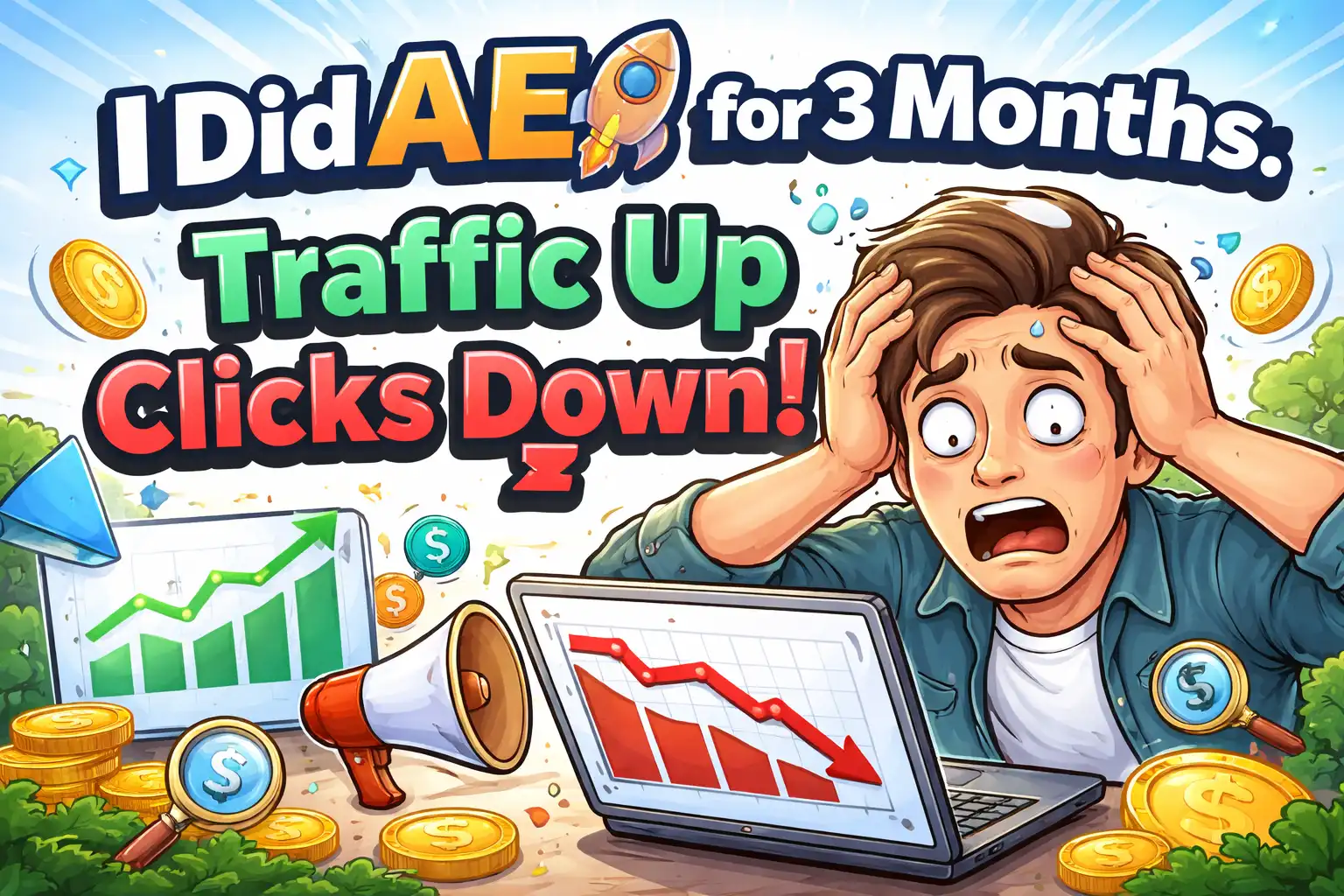
Last autumn I devoted an entire quarter to rewriting over a hundred old articles on my site. I added structured data, organized FAQ Schema, and began each paragraph with the most concise sentence that directly answered the user’s question. The impression curve in Google Search Console looked like an ECG that suddenly started beating, climbing steadily. I leaned back in my chair, feeling confident.
Then I glanced at the real traffic analysis—the curve was almost flat.
Later I realized that AI summaries were eating my click‑through rate. Impressions rose, but users didn’t need to click into my site; they read the answer directly in the summary box on the search results page. In that instant a question popped into my head: what exactly am I optimizing?
SEO and AEO are two different games, yet many people treat them as the same thing. What’s the difference? Here’s a direct answer: SEO optimizes the probability that a user clicks your link on the results page; AEO optimizes the probability that an AI model extracts your content as a source when generating a summary. The metrics, strategies, and even failure modes differ.
I spent three months figuring out where AI actually reads my content
The story starts at the end of 2025. I was running a Chinese blog for a SaaS tool, targeting the keyword “AI content automation”. Traditional SEO is clear: write long‑form articles, build backlinks, optimize page speed. I followed that logic for six months, and rankings did rise.
The problem appeared during a routine content audit.
I pulled keyword rankings with Ahrefs and saw that the core term “AI content automation” jumped from page 4 to page 2—a good sign. Yet traffic from Google dropped by 12 %. I initially blamed seasonality, until I opened the “Search Appearance” report in Google Search Console.
AI summaries accounted for 37 % of total impressions.
In other words, Google’s AI Overviews were pulling my article content directly as the answer, so users got the information without ever clicking my site. The content I spent three months writing turned into material for AI answers—without a single click.
This isn’t an isolated case. Recent research shows that after AI Overviews appeared, the probability of users clicking traditional blue links fell by 15 %–25 %. Moreover, the data sources AI engines prefer differ completely from traditional search. In my observations, user‑generated platforms like Reddit and Quora are cited far more often in AI summaries than authoritative corporate blogs. For a question like “How to choose the best AI writing tool,” AI tends to cite a Reddit discussion rather than a vendor’s product page.
This forced me to rethink the basic assumption of my content strategy: am I writing for people or for AI? If it’s for AI, its reading behavior is completely different from a human’s.
The hidden trade‑off between traditional SEO and AEO: sometimes perfect structured data hurts
While tweaking content, I discovered a counter‑intuitive fact: perfectly done structured data doesn’t always help you get traffic.
Sounds like a joke, right? The first lesson in any SEO class is how to write Schema. But what happened to me was this: I spent a weekend adding FAQPage Schema to every article, giving each question a concise answer, fields neatly aligned. Two weeks later, AI summaries began referencing my content frequently—but the site’s click‑through rate fell by 19 %. The reason: AI displayed my FAQ content as the final answer on the search page, so users didn’t need to click through for the full article.
This creates a dilemma: do you want your content cited by AI to build brand authority, or do you want users to click your site for direct conversion? Under the AEO framework, these goals are not always compatible.
I mentioned a similar issue in the article “The Illusion of Efficiency: Scaling SEO Content Creation in 2026.” Many chase AI visibility while overlooking a basic fact: AI summaries provide zero clicks, not rankings. Zero‑click searches accounted for over 45 % in 2026. If you focus only on impressions and brand mentions, you may end up unable to sustain ad revenue.
So what’s an effective strategy? Based on my experiments, three tactics actually work:
- Provide content AI can’t “swallow whole”: tables, comparison charts, multi‑step processes, interactive data—these are hard for AI to fully render in a summary, forcing users to click.
- Brand mentions and PR signals: AI model training heavily relies on third‑party brand endorsements. A discussion on Hacker News, Product Hunt, or industry forums about your product is more valuable than ten self‑written promotional articles. Even without backlinks, natural brand mentions can significantly boost your presence in LLM outputs.
- Content update frequency need not be high, but updates must carry timestamps: AI is extremely sensitive to freshness. If one article says “According to statistics, Q3 2024 shows…,” while a competitor’s article says “According to statistics, Q1 2026 shows…,” AI will prioritize the newer one, even if your article originally ranked higher.
Traffic attribution is becoming a joke
If you’re still using the “Last Click” model in Google Analytics to evaluate AEO performance, you’re probably being badly misled.
In the first half of 2026 I ran a small experiment: I compared conversion from ChatGPT‑generated search traffic with traditional Google search traffic. The result was painful—ChatGPT‑sourced visitors stayed 62 % longer on average and converted 4.4 times more. Yet the source channel for these users showed up as direct/none because they clicked the link inside the AI conversation, bypassing the traditional keyword search path.
What does that mean? It means the money you spend on PR, the time you spend answering questions on forums, the content you produce on video platforms—all of these are “untrackable” in traditional attribution models. They may influence AI training data, but you see nothing in your analytics dashboard.
I tried solving this with UTM parameters, but quickly discovered it’s impossible. The interaction between user and AI happens inside a closed chat window; AI never appends utm_source=chatgpt to your links. You lose visibility into the first half of the user journey.
This isn’t a bug in a tool; it’s a structural shift in the search paradigm. When search behavior changes from “type a query, browse results, click a link” to “ask a question, get a summary, decide whether to dive deeper,” the old attribution system collapses.
I eventually gave up on perfect tracking and focused on two more practical metrics: brand mention rate in AI summaries and changes in brand search volume. If you see the number of times the brand “SEONIB” is explicitly mentioned in AI search results rising, and the number of direct Google searches for “SEONIB” also increasing, that indicates the AI layer is indeed bringing in new users—even if you can’t trace a specific source.
Lessons from automation failures: the day I forgot metadata
Automation is the most underestimated risk in an AEO strategy. I’ve seen many people push out dozens of articles with one click, only to have AI summaries pull the wrong language version from a multilingual site.
I made a particularly foolish mistake myself. At the end of last year I wrote an automated publishing script that synced content to five different platforms. The script ran for two weeks and everything seemed fine—until I randomly opened a freshly published article and discovered that the HTML <title> tag’s meta description was truncated because the platform’s editor imposed a character limit, and my script didn’t adapt the field.
For an entire month, every article’s description became “AI content automation tool for”—a half‑sentence. Google didn’t index those pages, wasting two weeks of content production. The incident cost me roughly $2,000 in ad spend and a month of ranking progress.
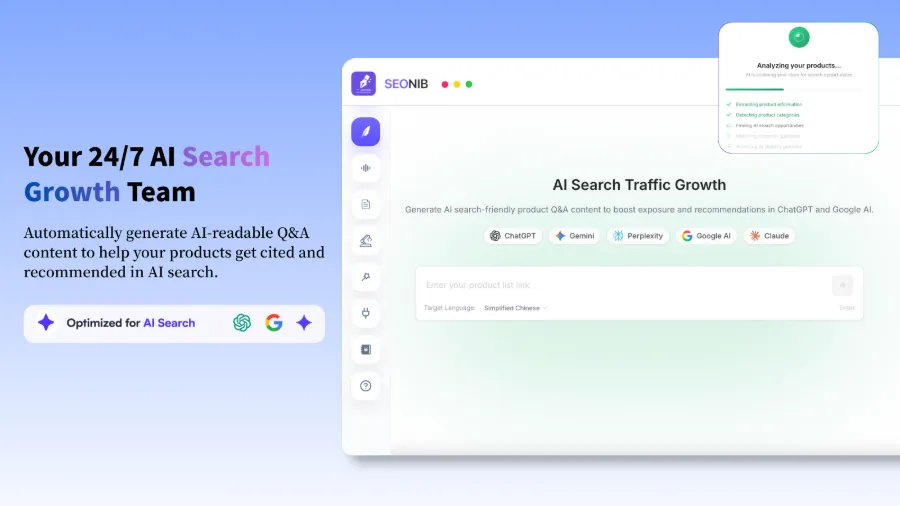
Later I switched my reliance on automation to a more controllable tool. I tried using SEONIB to handle part of the publishing workflow because it automatically adapts field lengths and formats when syncing across platforms, eliminating the repetitive manual adjustments of meta information across different CMSs. In short, the value of such tools isn’t in writing content—writing isn’t the problem; the real bottleneck is the entire distribution, formatting, and indexing pipeline after the content is finished.
SEONIB solved the publishing‑side synchronization issue, but for AI‑summary‑level optimization I still perform manual reviews. Automation can save you time, but it can’t decide “which paragraph of this content AI will cite in its summary.”
Frequently Asked Questions
What’s the difference between AEO and GEO?
AEO aims for your content to be directly cited in AI summaries, suitable for brand awareness and informational content. GEO emphasizes the recommendation weight of your content in generative AI outputs, involving more complex model signals and suited for conversion‑focused content. At the operational level, their Schema strategies and content structure requirements are essentially the same.
Why are my impressions high but click‑through rate low?
Most likely because your content is being fully displayed in AI summaries. Check the “Search Appearance” report in Google Search Console; if “AI Overviews” exceed 25 % of impressions, your content satisfies user intent without driving clicks. Consider adding elements that require user interaction, such as calculators or comparison tables.
Do I need to stop traditional SEO to do AEO?
No, but you need to adjust priorities. The brand‑search component of traditional SEO remains effective, but the value of “ #‑1 ranking” itself is declining. Allocate about 30 % of your content budget to “AI‑citable authoritative content,” and keep the remaining 70 % on deep, intent‑driven content for user searches.
What should I watch out for when doing AEO with multilingual content?
AI models weigh data sources differently across languages. Chinese content is more likely to be cited from Baidu Baike and Zhihu, while English content leans toward Wikipedia and Reddit. Ensure each language version includes at least three natural brand mentions on local authoritative platforms.
How many metrics should I track to evaluate AEO effectiveness?
Three are enough: brand mention count in AI summaries, change in direct brand search volume, and change in the proportion of zero‑click search results. Other metrics can be used for reference, but they shouldn’t be core KPIs because the attribution chain is too fuzzy.
Share Article